Maybe AI Art Isn’t the Problem
The internet is drowning in AI slop, but at the Southbank Centre’s new Creative Intelligence festival, artists are using technology to examine memory, labour, ecology and identity rather than simply generating another woman with seven fingers.

For the past few years, the conversation about artificial intelligence and art has been as subtle as a typical Twitter/Threads argument. Either AI is a revolutionary creative partner that will democratise culture, or it is a plagiarism machine preparing to replace every illustrator, writer and moderately employable person.
Both sides have evidence. Generative AI has produced an almost infinite supply of strangely glossy images: identical fantasy porn, imaginary interiors with structural problems, Wes Anderson versions of things that never needed to become Wes Anderson films. It has also been trained on the work of artists who were neither asked nor paid, while tech companies present the resulting products as spontaneous machine creativity.
It is understandable that “AI art” has become shorthand for everything cheap, uncanny and ethically suspicious about the current technological moment. But perhaps AI art itself is not the real problem. Perhaps the problem is what happens when corporations control the technology, design it for speed and scale, and use it primarily to avoid paying somebody to make something properly. Technology does not arrive with an artistic position built in. Artists give it one.
This is the more interesting territory explored by Creative Intelligence, the Southbank Centre’s new three-day festival of art, technology and experimentation. Across installations, performances, talks, games, live-coded music and even robot combat, the programme asks a better question than whether AI can make art: what can artists reveal about the systems already reorganising our lives?

AI is not floating in the cloud
The fantasy surrounding artificial intelligence depends partly on making its infrastructure invisible. We type a prompt into a clean white box, and an answer appears. The process feels weightless, almost magical (which is convenient if nobody wants to think about the mines, factories, warehouses, energy, data and human labour behind it).
Kate Crawford and Vladan Joler’s Anatomy of an AI System does the opposite. The large-scale map traces the physical resources, labour and data required to produce and operate a voice-controlled device. Rather than treating AI as an independent intelligence living somewhere in “the cloud”, the work exposes it as a vast planetary system.

Its intelligence is built from lithium, logistics networks, low-paid labour, personal information and enormous quantities of energy. Even the most futuristic technology remains stubbornly attached to the earth and to the people whose work is usually edited out of its origin story.
This may be one reason so much mainstream AI imagery feels culturally empty: the systems are presented as if they emerged from nowhere. Crawford and Joler put the missing context back in.
What if the algorithm wasn’t designed for us?

Alexandra Daisy Ginsberg’s Pollinator Pathmaker uses computational technology differently. Instead of asking an algorithm to produce an image for human consumption, the project uses it to design gardens from the perspective of pollinating insects.
Humans may find the resulting planting beautiful, but we are not its primary audience. The work is made for bees, moths, butterflies and other pollinators whose habitats are disappearing.
It is a subtle but fairly radical reversal. Most technologies are designed around human convenience, attention and profit. Ginsberg uses an algorithm to imagine the needs of other species — effectively asking technology to help humans become less central.
The work also complicates the idea that digital art must exist on a screen. Here, computation becomes flowers, food and habitat. The algorithm is not the finished artwork but part of a process that produces something alive.
The body has not been cancelled
One of the least convincing promises of technological culture is that the body will eventually become irrelevant. We will transcend geography, biology and physical limitations, presumably while sitting in an ergonomic chair owned by a venture-capital-backed wellness company.
In Vestige, Kevin Peter He examines how technology might mediate touch, memory and heritage. The questions are intimate rather than abstract: what happens when physical connection can be translated into data? Can technology preserve the sensation of another person, or does it only produce a technically impressive imitation of closeness?

Elsewhere, Playing with Fire: An Immersive Odyssey with Yuja Wang places a digital avatar of the pianist inside a mixed-reality concert. The project does not remove Wang’s physical performance from the equation. Instead, it stretches it across different forms of presence, asking what a portrait of a musician might look like when sound, body, memory and digital image occupy the same environment.
Who gets to build the future?
The problem with many visions of the future is not that they are unrealistic. It is that a remarkably narrow group of people creates them and then presents them as inevitable.
Danielle Brathwaite-Shirley’s practice uses video games, archives and interactive environments to centre Black trans lives. The audience cannot remain a neutral spectator. Participation comes with choices, discomfort and responsibility.
This changes the role of technology. Instead of functioning as an escape from politics, the digital environment becomes a place where power, access and memory can be reorganised. The important question is no longer whether a game or virtual world qualifies as serious art. It is who has been permitted to appear in our cultural archives — and who gets to decide how they are represented.
The festival’s Living Mythologies strand expands this idea through works by Brathwaite-Shirley, Ayoung Kim, Andrew Thomas Huang and Liam Young. Their immersive worlds do not offer the future as a frictionless upgrade. They use fiction and technological speculation to explore how societies might move through uncertainty, and whose histories will survive the transition.
The machine is not automatically the author
Of course, none of this resolves the most uncomfortable question: what happens to artists when machines can generate recognisable creative work in seconds?
Writers Jeanette Winterson and Jack Thorne address creativity and authorship directly during the weekend, while Holly Herndon’s practice offers one of the clearest examples of how an artist can work with machine learning without pretending that the machine appeared from nowhere.


Herndon has long treated the voice as both an intimate human instrument and a form of data. Her work with AI asks who owns a voice, who is allowed to reproduce it and how consent might operate when a person’s creative identity can be technologically simulated.
This distinction matters. There is a significant difference between an artist deliberately training and shaping a system as part of a practice, and a company absorbing millions of existing works into a commercial model and calling the result innovation.
Please touch the art
Creative Intelligence is structured less like a conventional technology conference and more like an experimental public playground. The programme extends across the Southbank Centre’s 11-acre site, including the Creative Intelligence Summit, interactive installations, workshops, live demonstrations and an Exploration Bazaar involving institutions such as Goldsmiths, the Royal College of Art, University of the Arts London and Google Arts & Culture.
Peckham Digital brings London’s grassroots creative-computing scene into the Queen Elizabeth Hall foyer with feminist cyber decks, interactive works, performances, a zine library and robot combat. On Saturday evening, the space becomes an Algorave, where music is generated and manipulated through code in real time.
The emphasis on participation is important. Artificial intelligence is often described as an unstoppable force being delivered to a passive public. Creative Intelligence proposes that people should be allowed to open the machinery, question it, play with it and occasionally make it behave strangely.
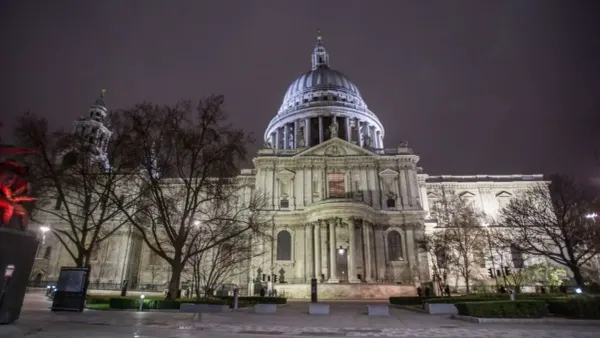
It also reconnects the festival to the Southbank Centre's history. The site emerged from the 1951 Festival of Britain, which used architecture, science and design to imagine a more optimistic postwar future. Seventy-five years later, technological optimism is harder to perform without irony. We have seen too many platforms promise connection and deliver targeted advertising.

The most convincing works in Creative Intelligence do not ask us to trust technology. They ask us to look at it properly: at its materials, biases, labour, ecological consequences and creative possibilities. They treat AI not as an autonomous genius but as a tool, infrastructure and cultural battleground.
Perhaps bad AI art is not proof that machines cannot be creative. It proves that technology without intention, context, or responsibility produces exactly what we should expect: content.
Creative Intelligence takes place at the Southbank Centre from Sept 11, 2026 to Sept 13, 2026.