The 90s: Art and Fashion at Tate Britain Review — A Brilliant Decade Reduced to a Moodboard
Tate Britain revisits the decade that transformed British art and fashion in The 90s: Art and Fashion, guest-curated by Edward Enninful. But does the exhibition capture the spirit of the 1990s, or just its most famous faces?
Edward Enninful’s new exhibition has Kate Moss, Alexander McQueen, Sarah Lucas, Damien Hirst, raves and every possible ingredient for a blockbuster. So why does it feel oddly small?
I knew this was a serious fashion exhibition when I walked into the press view and immediately saw Anna Wintour touring the galleries. I had arrived with my hair tied up in a scrunchie. Nothing makes you reconsider your professional credibility quite as quickly.
I wanted to love The 90s: Art and Fashion. The subject is irresistible: the decade when British art, fashion, photography, magazines, nightlife and music stopped politely occupying separate rooms and began sleeping with each other.
Instead, the exhibition finds itself in a strange middle ground. It is not spectacular enough to work as a blockbuster, but it is not rigorous enough to function as a serious historical exhibition. It has all the right faces, outfits and references, yet never quite explains why this particular decade transformed Britain from a slightly embarrassed island into a global cultural export.
There is a lot of Kate Moss, though.
The exhibition brings together more than 100 works by almost 70 artists, photographers and designers. Edward Enninful, former editor-in-chief of British Vogue, guest-curated the exhibition and became fashion director of i-D in 1991 at age 18. He developed the exhibition with Tate curators Jessica Vaughan, Helen Little, Dominique Heyse-Moore and Celeste McEvoy, Tate Britain director Alex Farquharson, and the wider curatorial team.
Enninful’s personal experience is central to the project. It is not presented as a neutral history of the decade, but as the 1990s seen by someone inside its fashion and magazine culture while it was happening. That gives the exhibition energy and intimacy. It also creates its main problem: at times, it feels less like a museum exhibition than Edward Enninful’s extremely glamorous camera roll.
How the exhibition is organised
The show unfolds across seven thematic rooms, moving from anti-fashion and DIY culture to nightlife, body horror, minimalism, Cool Britannia and finally the rewriting of British history.
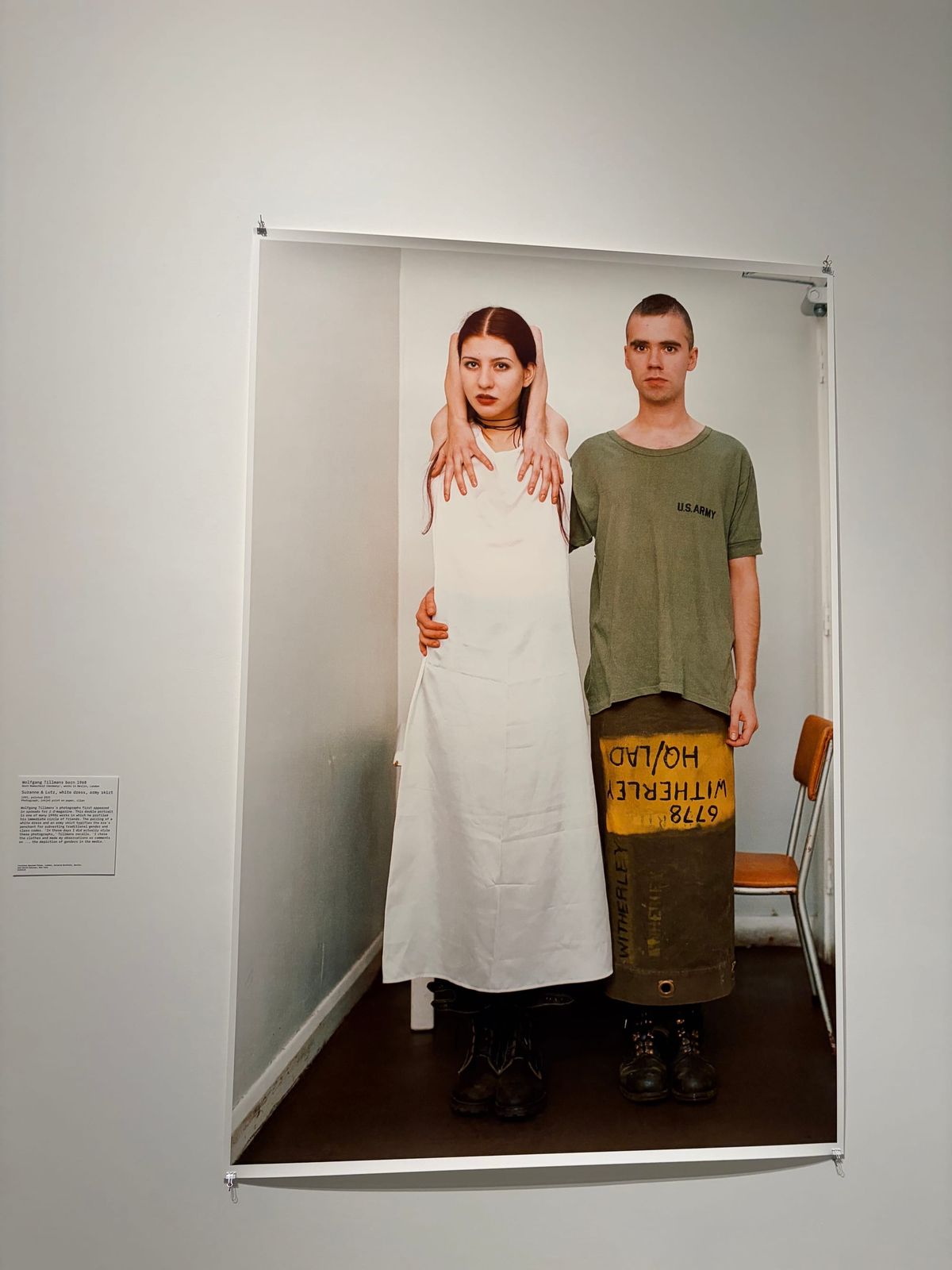
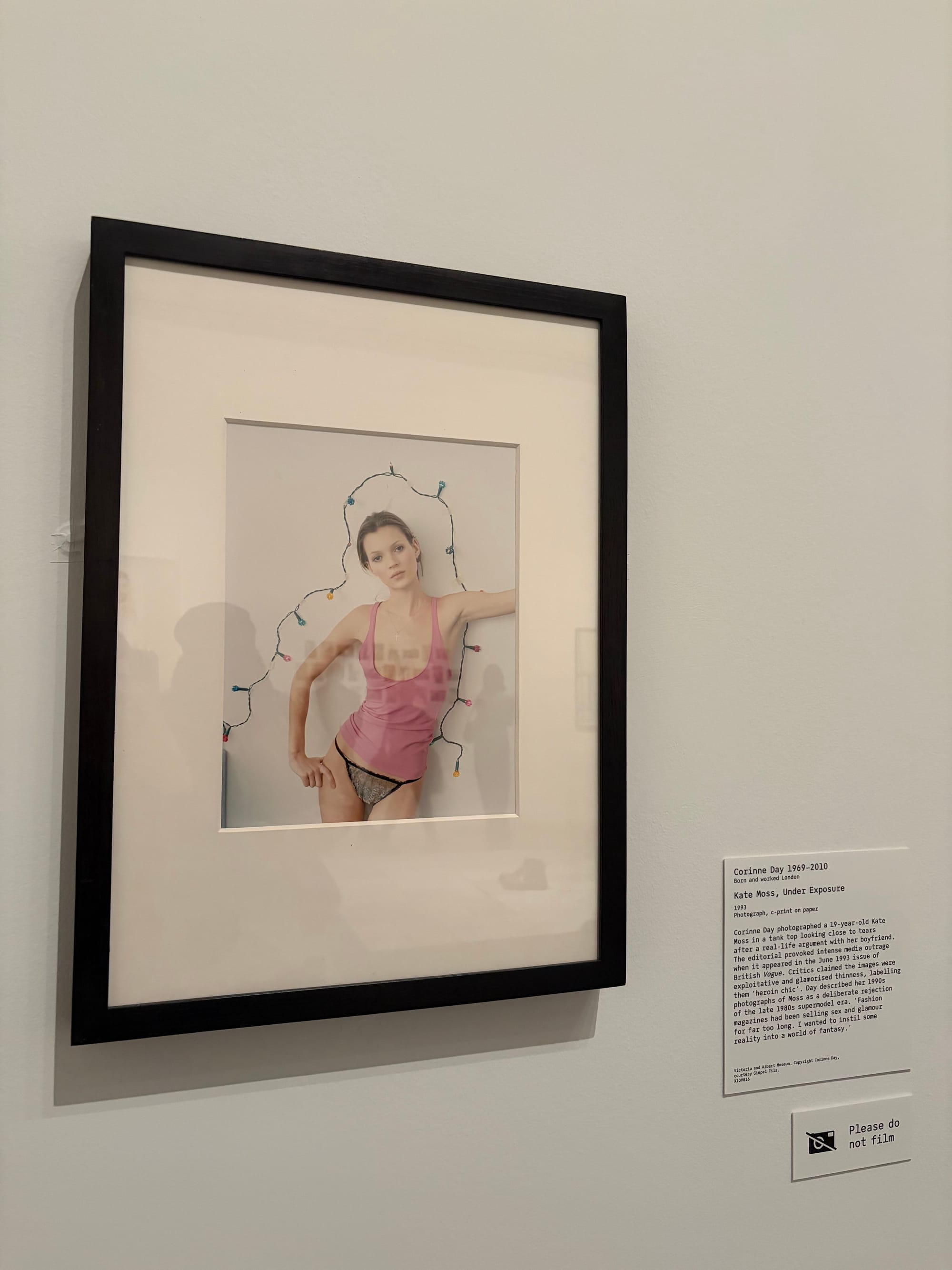
It opens with Jim Lambie’s striped Zobop, old television screens and photographs of the decade’s usual suspects: Kate Moss, Naomi Campbell, Goldie, Tracey Emin and Sarah Lucas. The first rooms, titled Be Real, bring together the deliberately unpolished photography of Corinne Day, Juergen Teller and Nigel Shafran with works by Lucas, Jenny Saville, Barbara Walker and Gillian Wearing.
Next comes I Can’t Get No Sleep, devoted to acid house, jungle, Bhangra and queer nightlife. Mark Leckey’s Fiorucci Made Me Hardcore plays among photographs of clubs and raves across Britain. Ironically, the room has no soundtrack: you access a Spotify playlist on your phone, a very 2026 way to experience the supposedly pre-digital freedom of the 1990s.
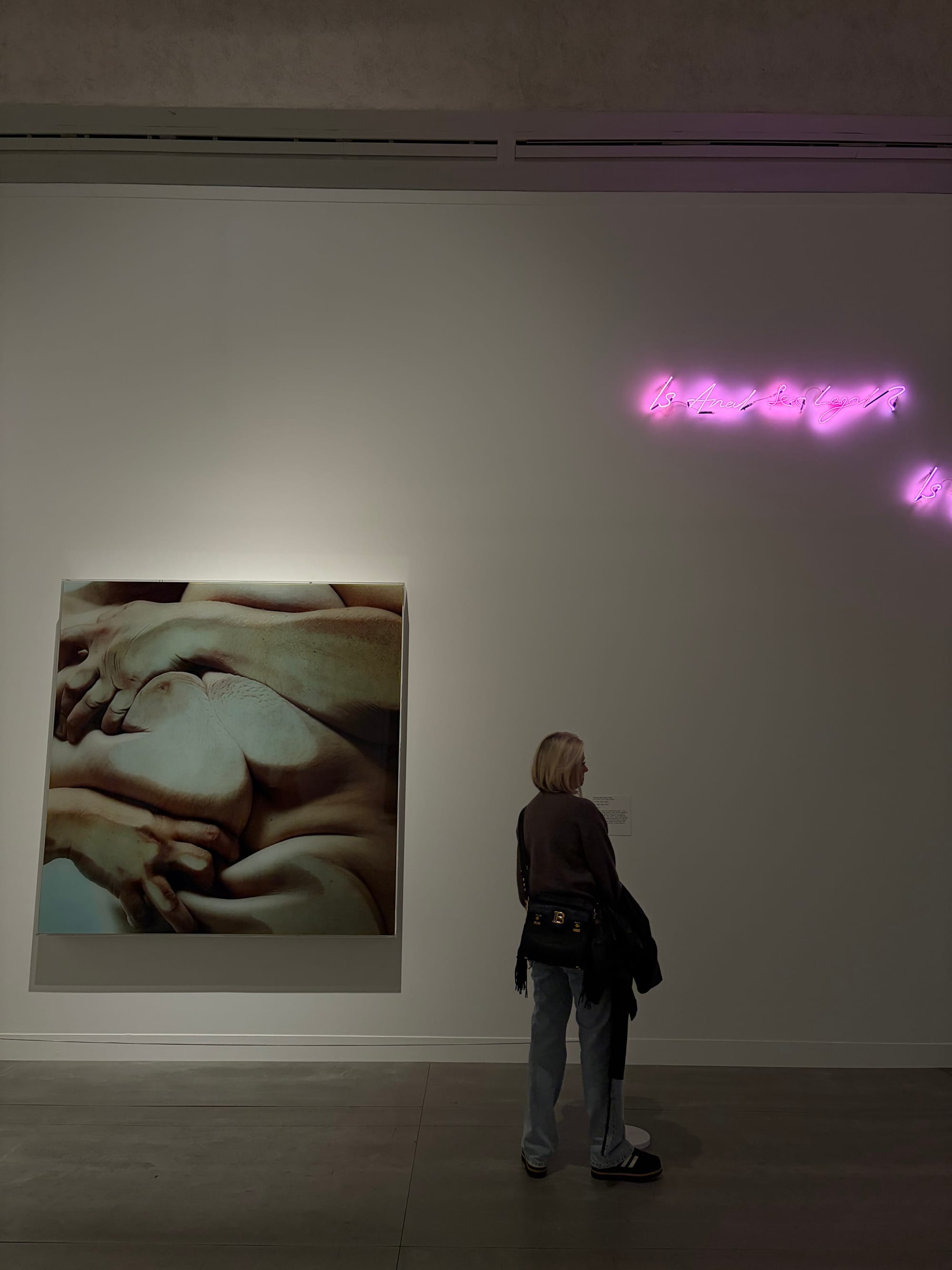
The exhibition then moves through body horror and the AIDS crisis, with Alexander McQueen, the Chapman brothers, Helen Chadwick and Hamad Butt, before arriving at the cleaner visual language of Damien Hirst, Rachel Whiteread and Hussein Chalayan.
The final rooms complicate the mythology of Cool Britannia through Steve McQueen, Chris Ofili, Keith Piper and Ozwald Boateng, before looking back at British history through Vivienne Westwood, John Galliano and Yinka Shonibare. Shonibare’s The Swing (after Fragonard) provides an elegant ending — perhaps slightly too elegant for a decade the exhibition keeps describing as chaotic.
The problem with The 90s
We see the result of Britain’s creative explosion without properly seeing the conditions that made it possible: affordable studios and terrible flats, art schools, grants, independent magazines, the YBA warehouse shows, the Turner Prize becoming national entertainment, New Labour turning “creative industries” into government language, and London discovering that culture could sell the country almost as effectively as finance.
The decade did not simply wake up one morning wearing a transparent slip dress.
This is particularly noticeable after the Design Museum’s excellent REBEL: 30 Years of London Fashion. That exhibition also included McQueen, Westwood, club culture, magazines and young British designers, but it had a clear curatorial proposition. It explored the infrastructure behind London fashion: the British Fashion Council’s NEWGEN programme, education, mentorship, press, nightlife, and the systems that let experimental designers build careers. Clothes weren't presented as magical objects that appeared out of nowhere.
At Tate Britain, history often becomes atmosphere. We get the famous people, the parties and the photographs, but not enough about the machinery that produced them.
Is it worth seeing?
Yes, because the 1990s remain fascinating, the clothes are beautiful, the photography is seductive, and Steve McQueen, Chris Ofili, Donald Rodney, Barbara Walker, and Yinka Shonibare have exceptional works.
It is also an accessible introduction for anyone who did not live through the decade and knows Cool Britannia mainly as an aesthetic currently being recycled on Pinterest.
But if you want to understand why British art and fashion became so powerful in the 1990s, you will need to bring some of that context with you.
The 90s: Art and Fashion has the look, the cast and the cultural references. What it lacks is what made the decade interesting in the first place: a sense that all this creativity emerged from specific political, economic, and social conditions rather than from Kate Moss being photographed particularly well. You leave the exhibition having seen Kate Moss from every possible angle, but still not entirely sure why Britain became the centre of the cultural world. Perhaps six photographs of Kate Moss are not, in themselves, a curatorial argument.
Ultimately, the exhibition is too small to be the blockbuster it promises and too glossy to be the serious historical survey it could have been.
The decade changed British culture. The exhibition mostly confirms that it photographed extremely well.
Credit: The 90s: Art and Fashion. Tate Britain, Millbank, London SW1P 4RG8. October 2026–14 February 2027. Daily, 10am–6pm. Tickets from £22