Renée Levi on September: Painting the Hayward Gallery Without Taking It Over
For her first large-scale public installation in the UK, Renée Levi transforms the Hayward Gallery’s Brutalist façade with September. We discussed her monumental new work and the shifting relationship between painting, architecture, and public space.
This autumn, Renée Levi’s September transforms the exterior of London’s Hayward Gallery with two monumental fields of colour painted by hand on industrial mesh. Co-commissioned by the Hayward Gallery and Audemars Piguet Contemporary, the work marks the Swiss artist’s first large-scale public installation in the UK.
We spoke with Levi about reading architecture before painting it, working at an unfamiliar scale, the physical presence of colour and what happens when painting leaves the gallery and enters the everyday life of the city.
1. You originally trained as an architect. How has that background shaped the way you approach a building as a surface for painting?
Perhaps architecture taught me, first of all, to read a building before doing anything to it. I look at how you approach it – from the front, from the side, from a distance – and at what you see from each position. I’m interested in how the building is used, how people move around it, and which parts of it you perceive at different moments.
With the Hayward, my first reaction was actually quite architectural – perhaps even rather Swiss. I wanted to understand the DNA of the building and not disturb it unnecessarily. Only after spending time there, walking around and observing how people use the building and its passageways, did I begin to understand where the painting could enter.
So I never thought of the façade as simply a very large canvas. The architecture was already there, and the painting had to find its place within it.
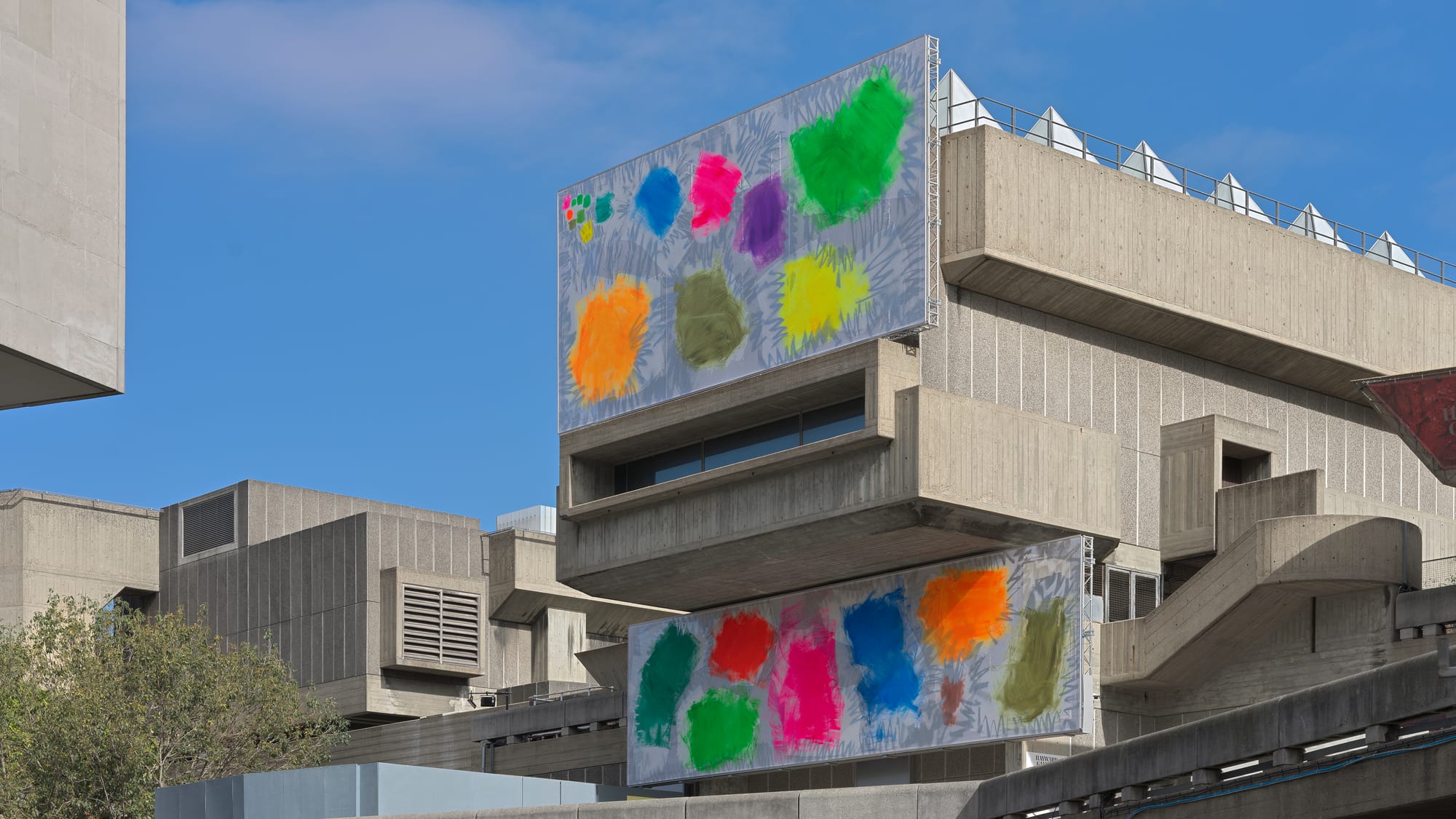
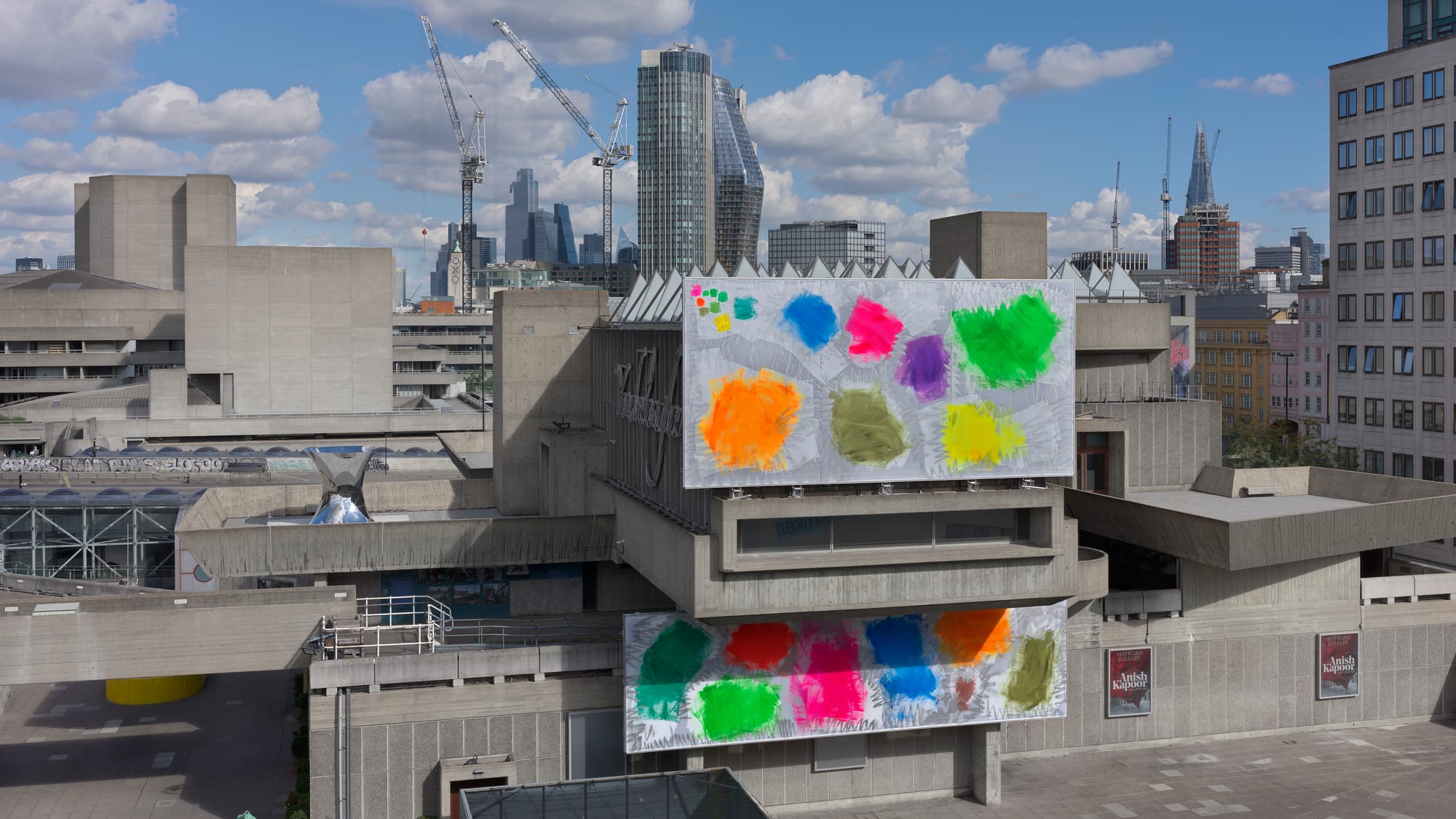
Renée Levi, September, 2026 © Courtesy of the artist and Audemars Piguet
2. What was your first response to the Hayward Gallery’s Brutalist exterior, and which elements of the architecture became the starting point for September?
What interested me was that the façade is not flat. It has projections and recesses, different depths, and this long horizontal window that I began to think of as an “eye”. But I didn’t want the eye to become the centre of the painting. It was already there, looking out towards the city, and I wanted to work with it rather than around it.
The two painted areas respond to different parts of the façade: the upper painting sits further forward, while the lower one is set back between the columns and is more affected by shadow. So they are two paintings, but the architecture between and around them is also part of the composition.
From a distance, you may first see the painting. As you come closer, the building becomes more present again. I like this changing relationship between painting and architecture.
3. The work both conceals and reveals the concrete beneath it. What interested you about creating this tension between the existing building and the new painted surface?
The mesh actually came from a technical necessity. We needed a material that could work at this scale outdoors and allow the wind to pass through it. At first, I wasn’t completely convinced by it. But once I started working with the material, I became interested in precisely what I had initially been unsure about – its transparency.
The painting is there, very physically, but the building doesn’t disappear behind it. You can still sense the architecture, the different depths of the façade, the shadows and sometimes the structure behind the mesh. The layers of PU, spray, and paint also behave differently on this surface.
I like that September changes the Hayward without taking it over. It is there for a short time, then it will disappear, and the building will remain.
4. How did you develop the colours and composition for a work at this scale? Was the process intuitive, carefully planned, or a combination of both?
There was a great deal of preparation. The mesh was new for me, so we had to test how the different layers – the PU treatment, spray and paint – behaved on it, and how the colours worked at a distance of perhaps 200 metres rather than a few metres in a gallery. The fluorescent and very intense colours came partly out of those tests.
Working with Audrey Teichmann, and with the support of Audemars Piguet Contemporary, gave me the chance to test these things properly rather than having to decide everything in advance.
But I wouldn’t really describe the other part as intuition. I think again of playing with rules. All this preparation creates the conditions for me to be free when I actually paint. The material, the dimensions, the architecture and certain colours are already there – these are the rules of the game. Once I start painting, I need to forget the preparation and respond to what is happening.
So perhaps it is very carefully prepared in order not to be carefully controlled.
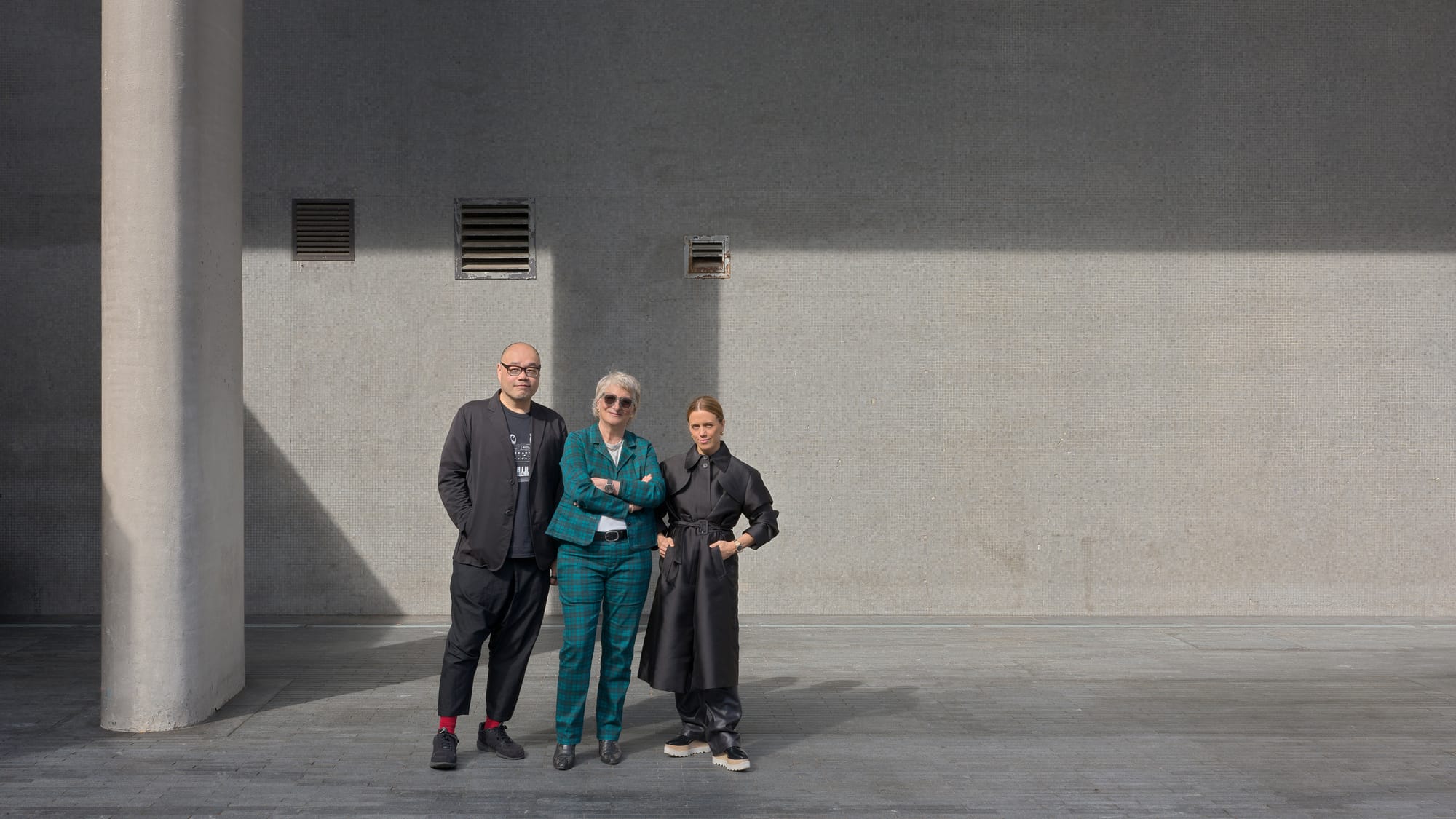
5. What does the title September mean to you, and how does it connect to the work and the moment in which it is being unveiled?
September has different layers for me. I often give my works women’s names, and September can be a woman’s name, too. But then there is the history of the word itself. Septem means seven in Latin, because September was originally the seventh month of the Roman calendar. Today it is the ninth. I like this small displacement – something in the name remembers a different order of time.
September is also a moment of transition. Summer is ending, the light changes, and something new begins. That felt right for a work that appears on the building for only a short time, then disappears again.
But I don’t want the title to explain the painting. It is more like a way of approaching it. The different meanings can begin with the title, but they don’t have to end there.
6. Your paintings often change the way people perceive and move through a space. How do you imagine the public encountering this work in the context of the Southbank?
What I like about the Southbank is that people are there for many different reasons. You don’t have to decide to visit an exhibition in order to encounter September. You may simply be walking to work, meeting someone or passing through.
For me, there is an important difference between seeing a reproduction – an advertisement, a printed image or something on a screen – and encountering an original. The experience is physical and sensory. You become aware of your own scale, your distance from the work, the material, the light, perhaps even the weather. You are no longer simply looking at an image; you become a counterpart to it, a person in relation to something physically present.
I like the idea that someone who passes the Hayward every day might suddenly look at it differently. Even if that happens only for a moment, that is enough.
7. How important are changing daylight, weather and distance to the way the work will be experienced over its two-month life?
They are very much part of the work. Outside, there is no controlled viewing condition. The painting changes with your distance from it, with the daylight and the weather, and again when it is illuminated after dark.
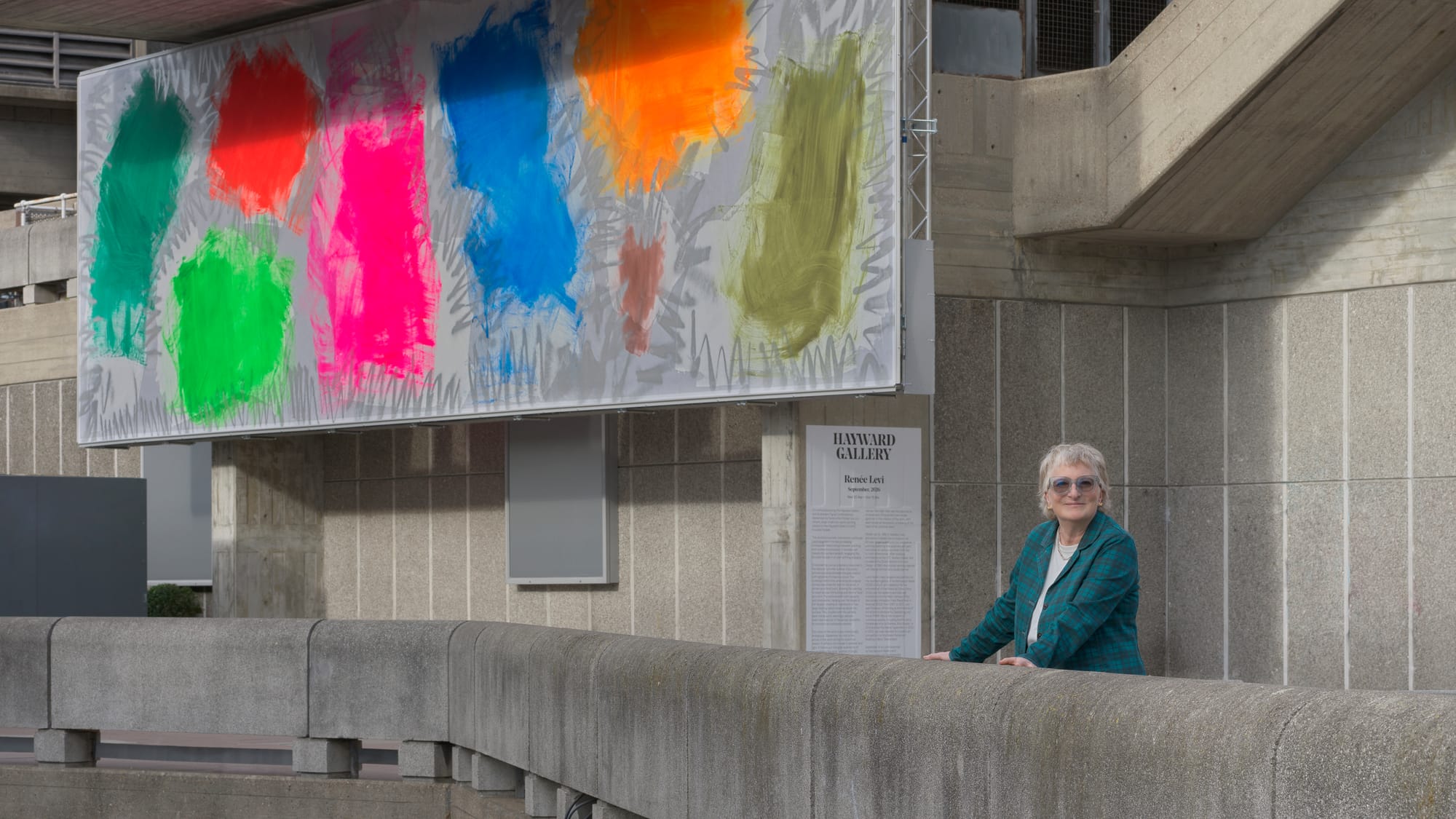
What I particularly like is when you can perceive the different physical layers: the concrete of the building, the aluminium frames, the open mesh, the primer and the untreated paint on top of it. The silver lines move somewhere between these layers, changing with the light.
From a distance, some of this disappears, and you may first see areas of colour. When you come closer, the construction and the material become visible again. And over the two months, the light and the season change. So September is never quite the same image.
8. What becomes possible when painting leaves the conventional gallery space and enters the architecture and everyday life of a city?
Outside a gallery, we have to remember that many people are more accustomed to large printed advertisements than to large paintings. At first glance, someone who has no particular relationship to art may not even know which context this belongs to. But there is no text, no logo, no message telling you what to think or what is being sold.
For me, it is very important that the colour is actually there, one to one. It is not a reproduction or a printed enlargement of a painting. What you see is the actual paint, applied directly by hand at the dimensions in which you encounter it. This gives the colour a physical presence in daylight that a reproduction cannot have.
After dark, when the work is illuminated, another layer appears. Electricity produces a different kind of radiance, and the relationship between colour, painting and building changes again.
Perhaps this is one of the things that becomes possible outside the gallery: painting enters a visual world we think we already know, but it doesn’t behave by the same rules.