How 5 Artists Picture War: Conflict Across Generations at The Wings of Peace
Presented during Art Basel Paris, The Wings of Peace brings together five artists from different generations to explore how war, violence and resistance have shaped artistic expression.
Toy guns under Plexiglas, war medals hanging like paint, ORLAN screaming behind a cracked window, and much more: in Paris, five artists born between 1937 and 1987 show how the image of war has changed over half a century.
During the Art Basel Paris, an exhibition called The Wings Of Peace opened its doors. Exploration of the concepts of conflict and peace within the same project did not seem to be a contradiction for its curator. “In a world where war is omnipresent, talking about peace without confronting the reality of war, its violence and the threats it poses, would, to me, be an unrealistic approach,” says Jean-Baptiste Chantoiseau, Director of Literary Museums in Rouen and the art historian.
The exhibition title already points out the key topic. It plays on Vers la paix perpétuelle. Translated to French, the headline of Immanuel Kant’s essay was written in 1795. As we can remember, Kant imagined peace as a political project, which is built through law and agreements between states. The exhibition starts from the other side. It means from what makes that project fail. And from what art can still do when it actually fails.
Organised by Tora and Art Foundation with the French cultural platform Bien En Place, the show is bringing together five artists working in diverse artistic mediums: Esther Ferrer, ORLAN, Oleg Kulik, Émeric Lhuisset and Léa Le Bricomte.
Each of them grew up with a different conflict in the background: the Spanish dictatorship, the Cold War, the collapse of the Soviet Union, etc. Exposed together, their artworks tell a story not only about war or conflict, but also about how they have learned to look at it.
Irony as resistance
Esther Ferrer, came to art in Franco’s Spain and in the 1960s joined Zaj, a group that questioned an authoritarian culture with absurdity and minimal actions. That method is still visible in Juguetes educativos (Educational Toys). Ferrer creates the artwork using commercial war toys, including: plastic pistols, soldiers, a racing car marked “Battle Force”, and fits their barrels with small phallic forms. A label on one of theml says “La violación arma de guerra” that can be translated as “rape as a weapon of war”.
The gesture is simple, almost a joke, and that is where its power is. Ferrer doesn’t demonstrate violence - she prefers to show where it is actually learned. The title does half the work: these toys are becoming “educational” because they really do teach. From childhood, people are told that a weapon is something to play with and that force is a masculine game. By adding one obscene detail, Ferrer makes visible what was already there. “The phallic forms incorporated into these weapons expose, more effectively than any formal treatise, the infantilism and irresponsibility inherent in acts of violence,” says Chantoiseau, curator of the exhibition.
Installation view of The Wings of Peace, Paris, 2026.
The body as a front line
For ORLAN the battlefield has always been the body. Since the 1960s, she has used her own flesh to question identity, challenge representation and the pressures society imposes, especially on women. Her answer to the theme of conflict comes from the same angle.
In L’Origine de la guerre, a lenticular work through which Courbet’s L’Origine du monde appears, she replaces the woman in the painting with a man. The reversal is more than a provocation. Courbet’s painting made the female body the origin of life. ORLAN’s version names the male body as the origin of war. It connects her to Ferrer: two artists of the same generation who are linking violence to a culture of masculine power. Working on scenography, Chantoiseau placed the artwork at the very start of the exhibition - near the entrance, as “a powerful, symbolic realization regarding the harms of power and domination, which have historically been masculine.”
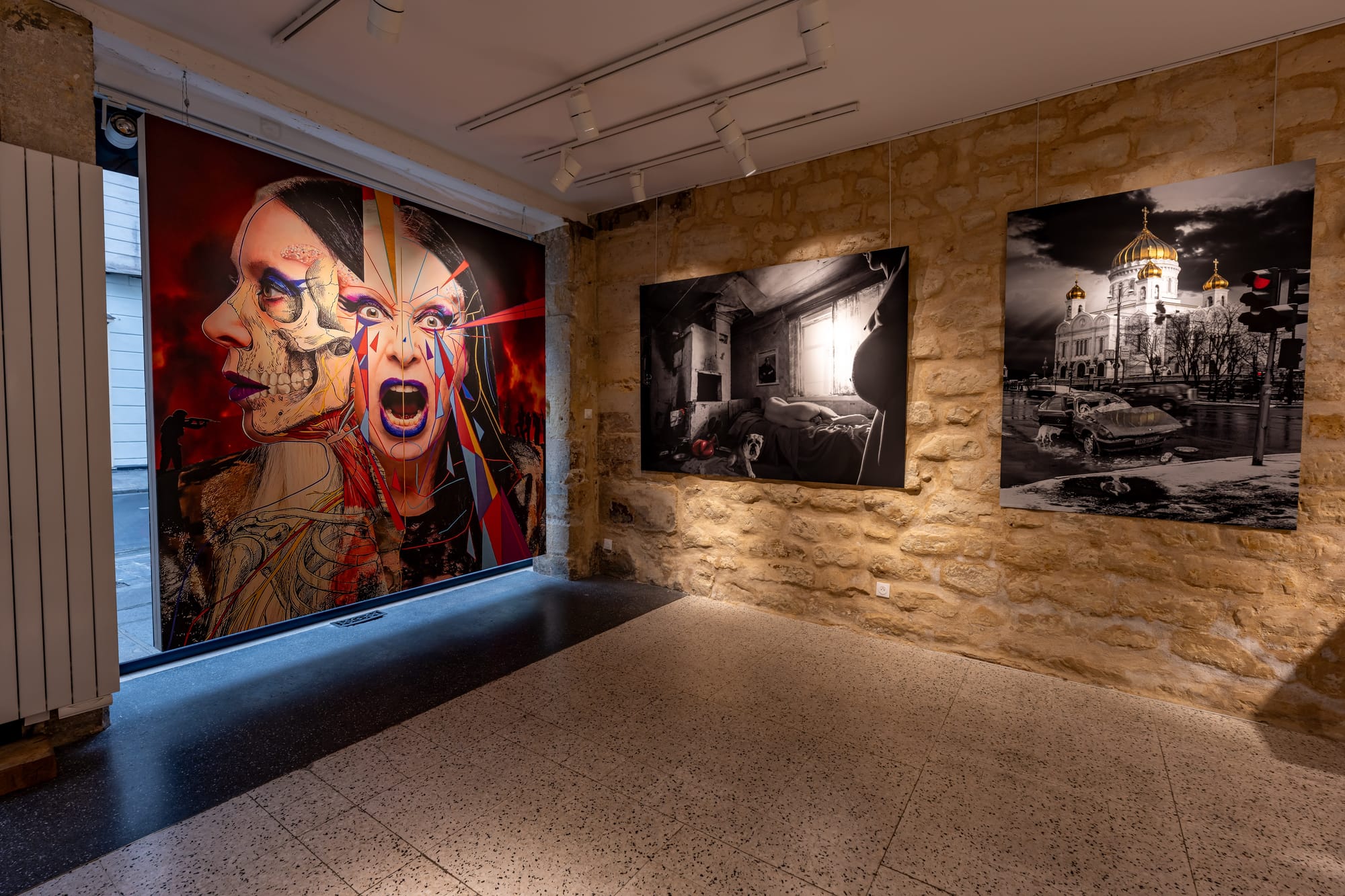
In two large self-portraits from Nous sommes inconsolables, currently also on view in Venice Biennial, ORLAN screams. The images come from filmed performances in which she shouts and cries. They could be read as despair, but she rejects that idea. “It is not a resigned complaint, but an active anger, a political anger,” ORLAN says. “This rage becomes artistic material, a driving force of creation and a gesture of resistance.”
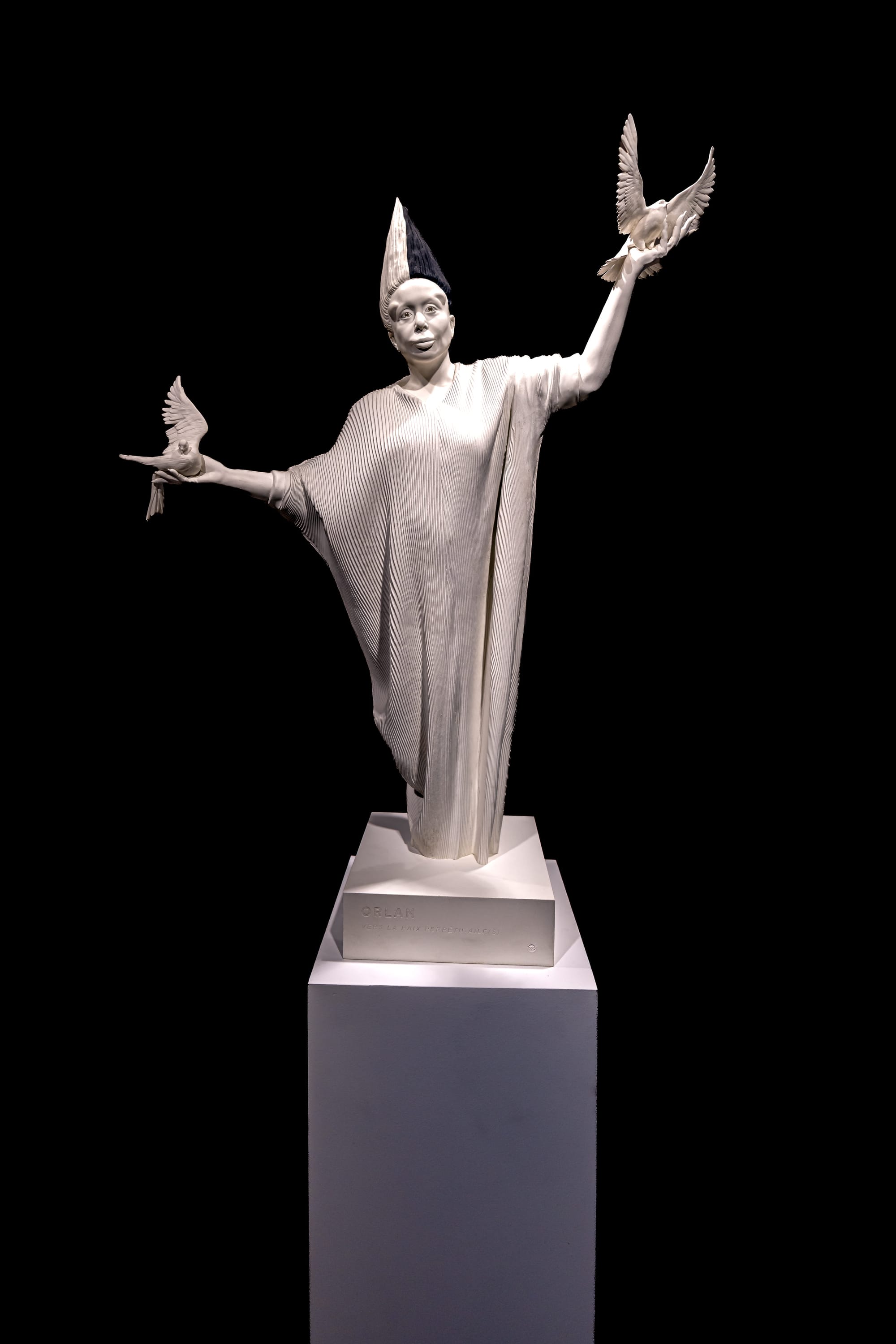
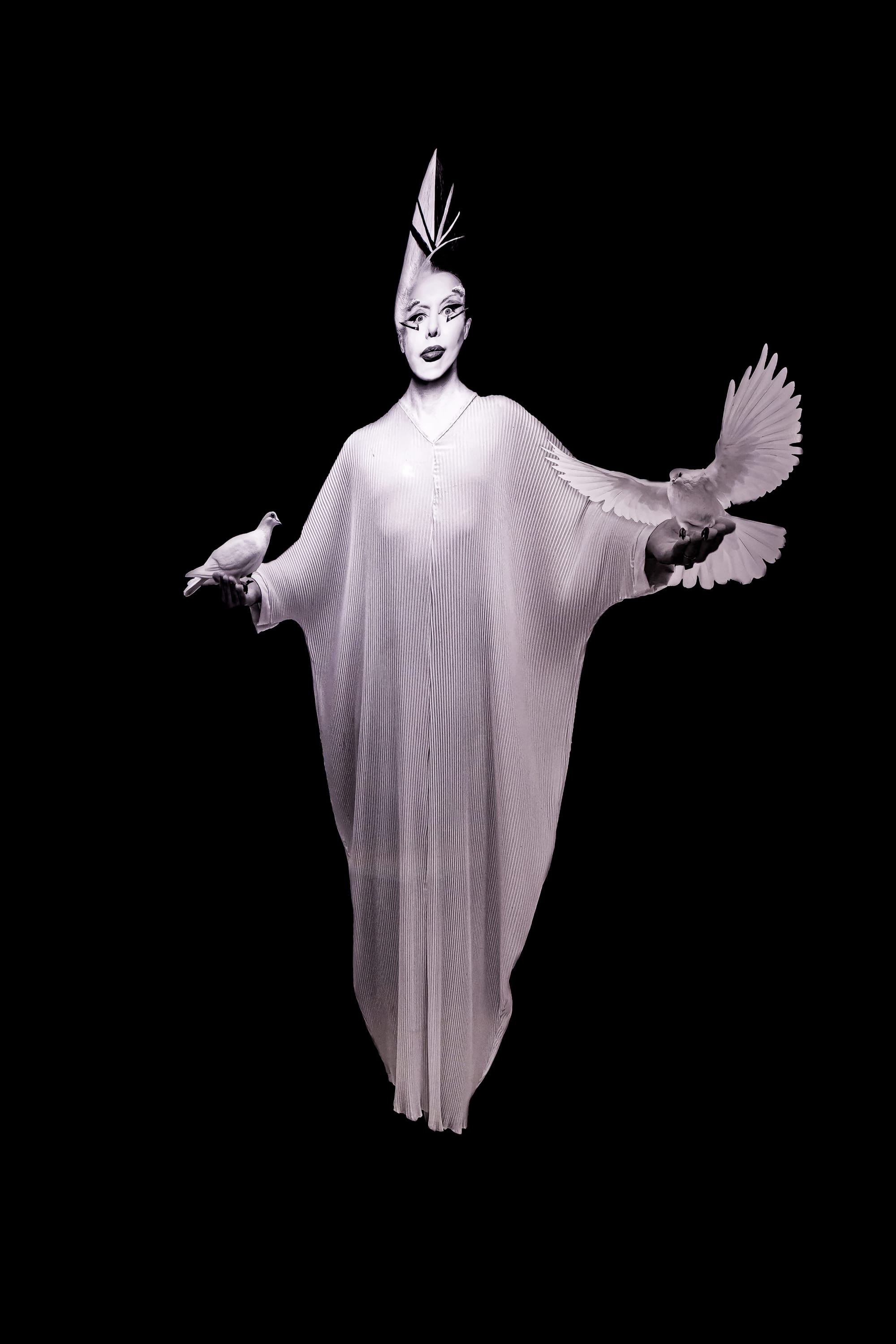
At the centre of the exhibition stands her white sculpture of a robed figure releasing doves. Made with the workshops of the GrandPalaisRmn using 3D scanning and a cast of the artist’s body, it continues a motif she first used in 1978. Also, it is a reference to the third of her Leçons d’artiste at the Louvre this year, devoted to art as resistance in times of war and oppression.
For Sarah Vinitz, founder of Tora and Art Foundation, this is what makes ORLAN central to the project. “Her exploration of the body as a site of freedom and self-determination gives particular resonance to our commitment to human dignity,” she mentions.
What connects Ferrer and ORLAN is a generation that believed the artist’s own presence, a body, a gesture, a provocation, could stand against power. “We are not on the side of violence, nor on the side of power,” ORLAN says, speaking about artists. “We are pacifists.”
After the empire
Oleg Kulik belongs to the generation that saw an empire fall. In the 1990s, he became one of the defining figures of Moscow Actionism, known across Europe for the performances in which he played a man-dog, a radical way of showing a society losing its human shape. In the exhibition. At The Wings of Piece exhibition he is represented by quieter artworks: photomontages from his iconic series The Russian.
In At the Church, a wrecked car stands in front of the gold domes of Moscow’s Cathedral of Christ the Saviour. In At Home, a bulldog stares out of a dark peasant interior. These are not images of war. They depict a society full of contradictions, absurdity and kitsch, where faith, poverty and violence sit side by side. Kulik borrows the language of nineteenth-century Russian realism, from the literature tradition of Tolstoy’s moral seriousness, and fills it with the chaos of the 1990s.
What makes these artworks matter today is time. Made almost thirty years ago, they still look like a forecast. Kulik’s images haven’t changed. The world around them has. In this sense, his artworks raise another layer of the exhibition’s sharpest questions: whether art sees conflict coming before politics admits it.
Into the field
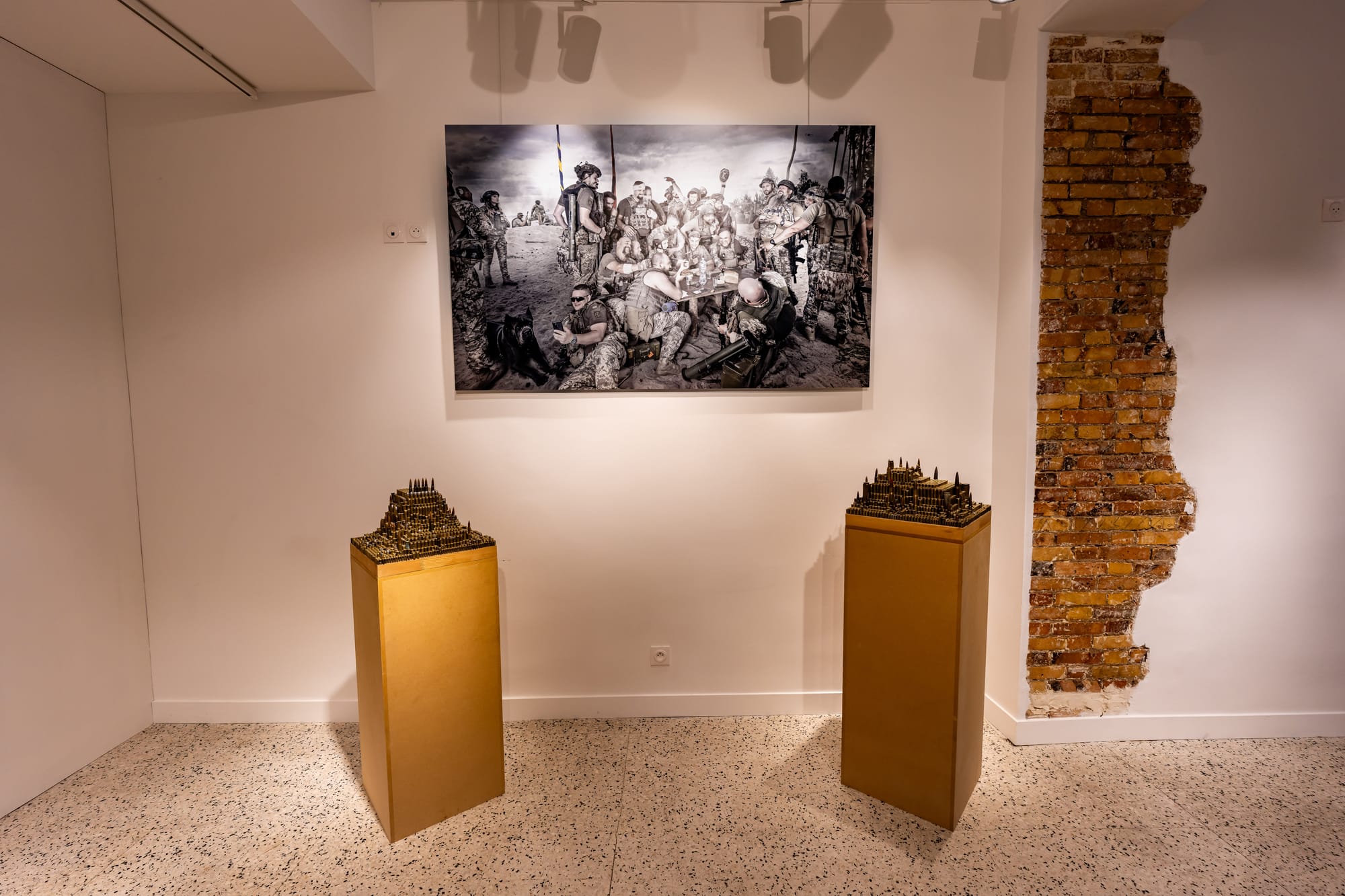
With Émeric Lhuisset the position of the artist changes. He doesn’t comment on the concept of conflict from an artist studio. His practice is built on direct engagement with high-risk environments and the communities living through conflict. J’entends au loin la réponse des cosaques (From far away, I hear the Cossacks’ reply) is a contemporary photointerpretation of Ilya Repin’s nineteenth-century painting Reply of the Zaporozhian Cossacks.
Repin’s painting shows laughter in the face of a threat: Cossacks composing an insulting letter to the Ottoman sultan. Lhuisset keeps the same laughter and the artwork composition, but the people are real, and so is the war happening around them. The artwork gives depicted soldiers a place in art history on their own terms, rather than as victims or statistics filling a news report. And it shows how history is repeating.
Here we can notice a generational shift. For Ferrer and ORLAN, the artist stands in front of power and answers it. For Lhuisset, the artist stands among the people living through the conflict. The approach has slightly changed. The artist no longer speaks for the subject - the subject becomes a part of the image.
Rearranging the remains
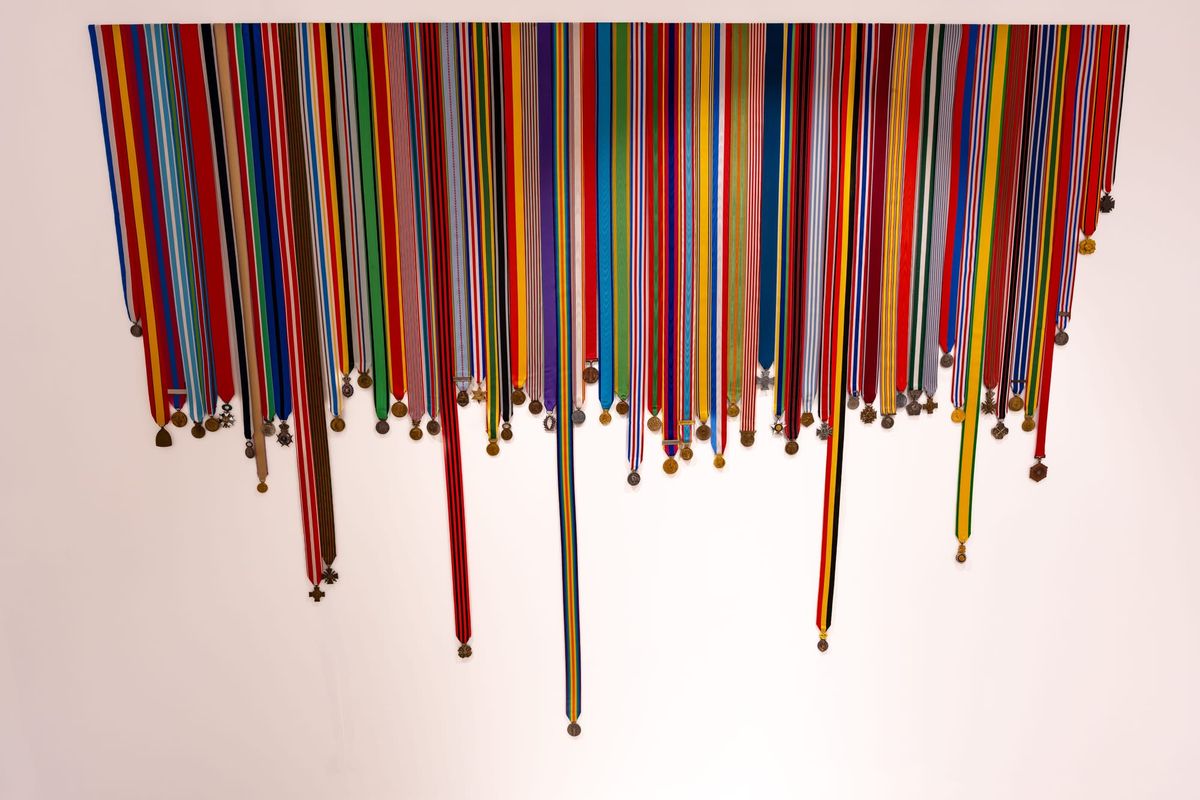
Léa Le Bricomte is the youngest artist participating in the show, and she grew up after the Cold War ended. She is working with the material that war leaves behind. Dripping Medals is created with the use of original First World War medals and ribbons hanging from the wall at different lengths. It can also be considered a reference to Morris Louis’s late stripe paintings of 1961–62.
The reference to American abstraction adds another layer. After the Second World War, abstract painting was promoted as an image of Western freedom during the Cold War. By hanging medals from the Great War in the manner of a colour-field canvas, Le Bricomte brings together two moments. Here, art and military power met, and shows how both ended up as just a decoration.
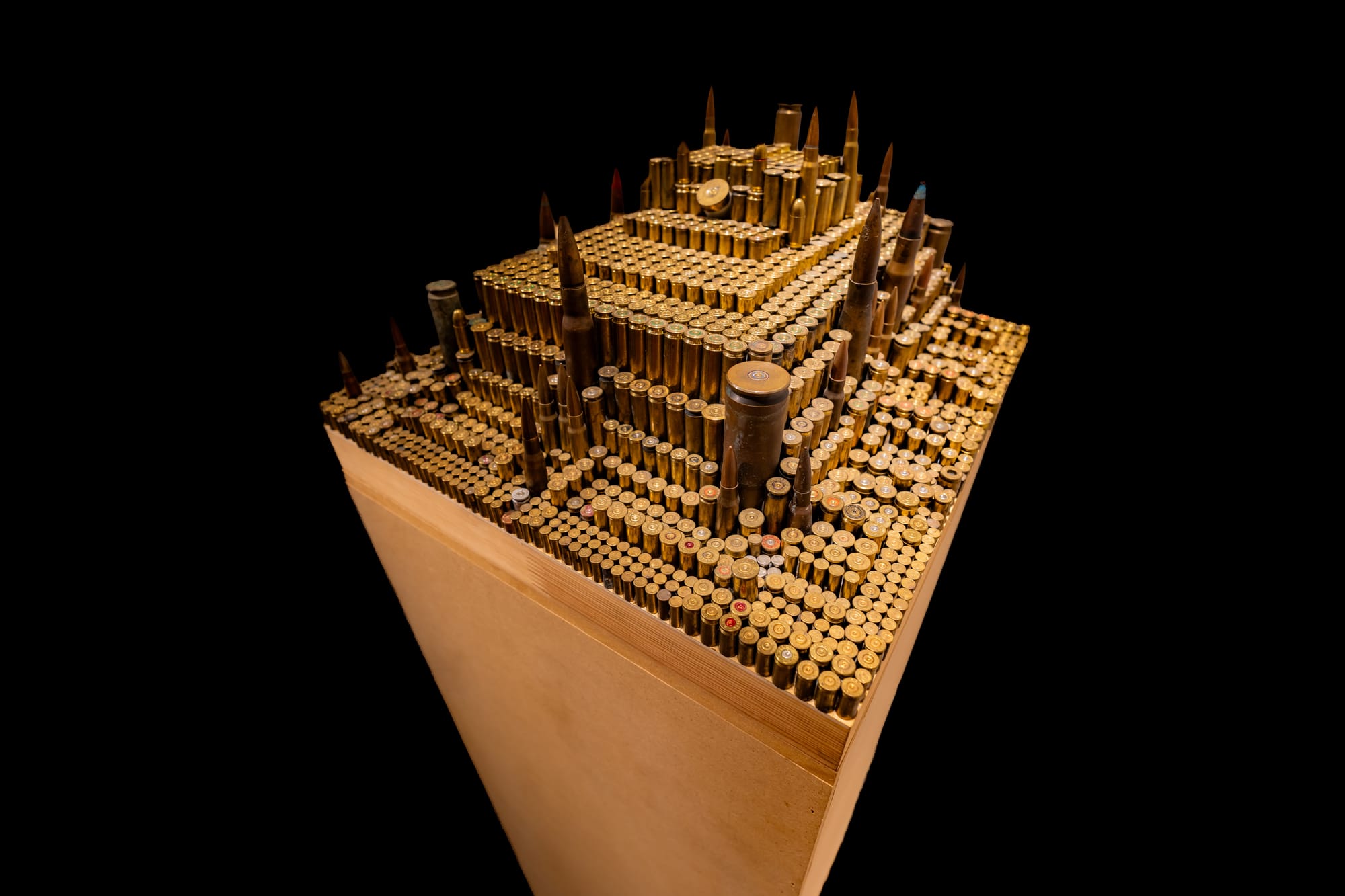
Spirit Houses is made of two miniature palaces built from cartridge cases.
The problem of shock
All five artists face the same difficulty: how to show violence to an audience that has already seen too much of it. Images of war now reach us every day, on screens and in feeds. Speaking about the project, Chantoiseau is aware of this. “As these images multiply, they lose their power,” he says. “It is often said that today’s public has become desensitised to such visuals, that nothing, anymore, is capable of shocking them.”
The exhibition’s answer is notable for what it leaves out. Each artist works by displacement: a toy instead of a weapon, a medal instead of a battle, a famous painting instead of a news photograph.
The violence is not shown directly, but it is recognised. That puts the responsibility on the viewer, who has to make the connection and contextualise it. According to the curator, he sees no contradiction in this. “The more freedom the public has to reflect and engage with a work and its subject matter, the more profound their encounter with art will be,” he says.
When reality walks in
The question of how art relates to real violence stopped being abstract before the exhibition even opened its doors. During the recent demonstrations in Paris, one of the gallery’s large-scale windows was slightly damaged. The organisers decided to keep this crack. “Reality entered the exhibition space and gave our statement new strength,” says Vinitz. ORLAN, whose work hangs in that window, described it in almost the same words: “The violence I represent in my work has been caught up by reality itself.”
Subscribe to our newsletter!
Weekly and monthly roundups of the best of London.