Anish Kapoor's Attractions: What the British Sculptor Makes You Think About
Not many who are immune to remain indifferent to Anish Kapoor's works: provocative, engaging and repulsive at the same time, they leave the viewer with open questions, subjects for reflection and exploration.
The new exhibition at the Hayward Gallery in London is no exception — a treasure trove for those who want to experience delight, fear or wonder. Like a fairground ride, only with brutal blood-red sculptures, a pigment so black it swallows all light, and steel curved figures gleaming in the scorching sun.
On Sacrifice
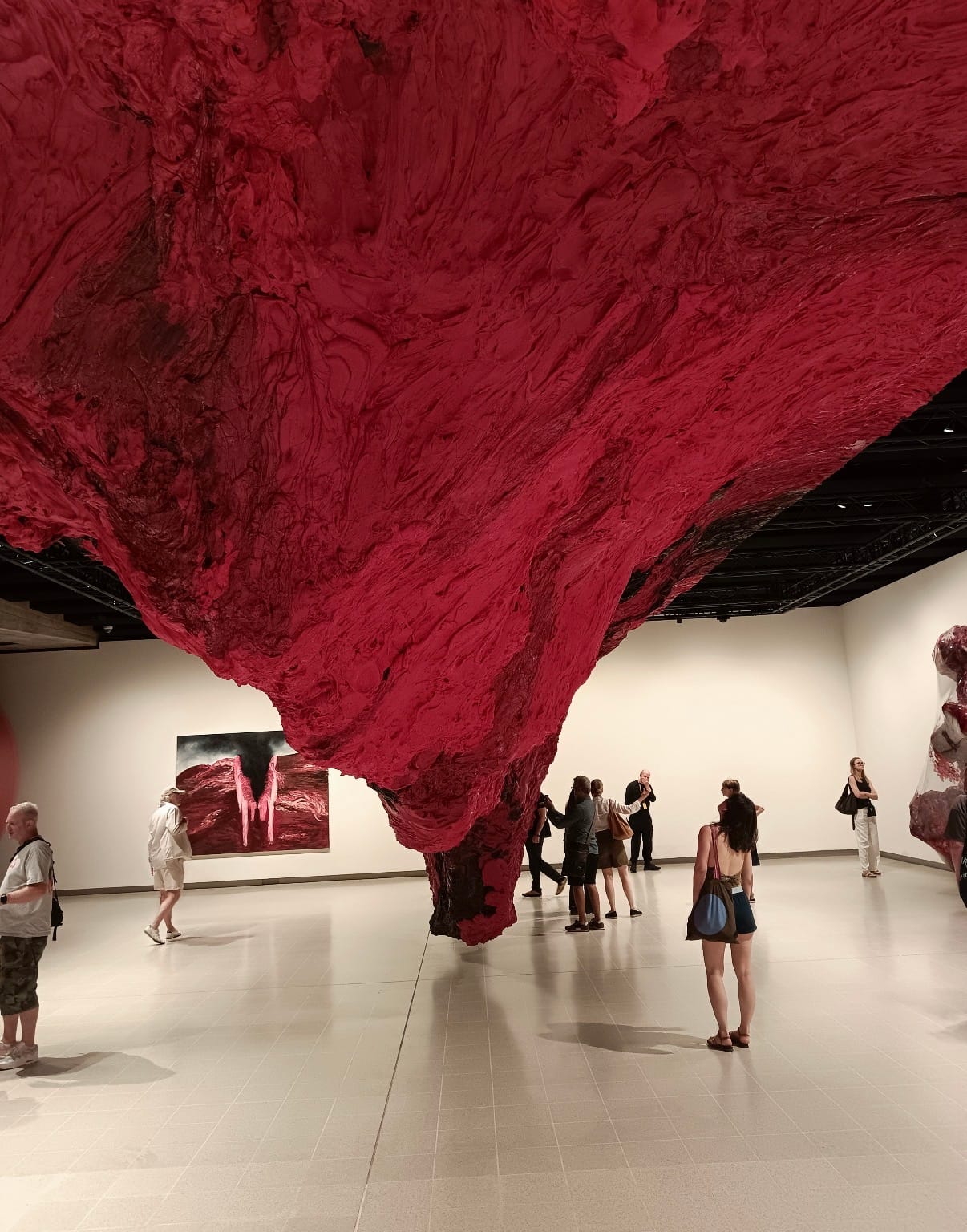
Anish Kapoor speaks about the dark aspects of human experience as if it were a horror film set. The upside-down Mount Moriah — where, according to the scripture, Abraham was about to sacrifice his son Isaac — is surrounded by entrails: enormous blood-red, dark liver-coloured offal in plastic bags. Whether sheep or human, we don't know. Because if the mountain hints at a world thrown out of balance, who can be sure it's still a torn-apart sheep.
In their gigantic scale they look repulsive, because it's hard to look your fears in the eye. The artist himself notes: "We carry within ourselves the mystery, the masked fear that sits behind the ritual act — the fear of death." And the mountain, hanging a hair's breadth from the floor, fills the viewer with a feeling balanced between wonder and horror.
A Little More on Rituals
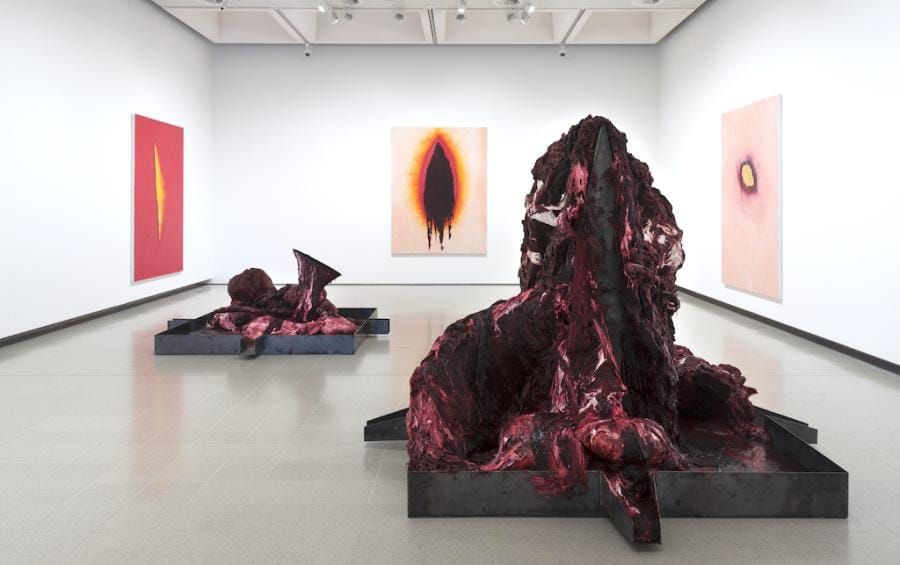
But the horror show doesn't end there: bare entrails, now without any packaging, await us in yet another room. Writhing forms resembling inflamed intestines, giant gallbladders — all of it oozing blood. Not literally, thankfully. Piled on a pallet, they evoke scenes from the film 4, and once again raise questions about the true nature of sacrifice.
The sculptures Ritual Atonement I, II and III are meticulously crafted, sweat-inducing objects that could quite plausibly belong to a human body. If media coverage of conflicts censors images of mutilated bodies deemed too shocking for viewers, Kapoor applies no such censorship — he invites us to confront life in a culture saturated with images of violence.
On Uluru
It's a gift when you can express your impressions in a form like a six-metre installation. Ha-Makom — Hebrew for "the place" — was inspired by the red mountain of Uluru in central Australia, which the artist considers the most sacred place he has ever visited. The installation resembles a rocky hill with a mysterious rectangular opening at its summit.
Taking the work's description as a starting point — that Kapoor seeks to evoke a sense of divine presence in space and time — one might imagine that the sacred point is concealed within that enigmatic, irresistibly beckoning opening. This object doesn't explain the mystical experience; it exists to create the conditions in which the viewer feels its presence.
On Reflection
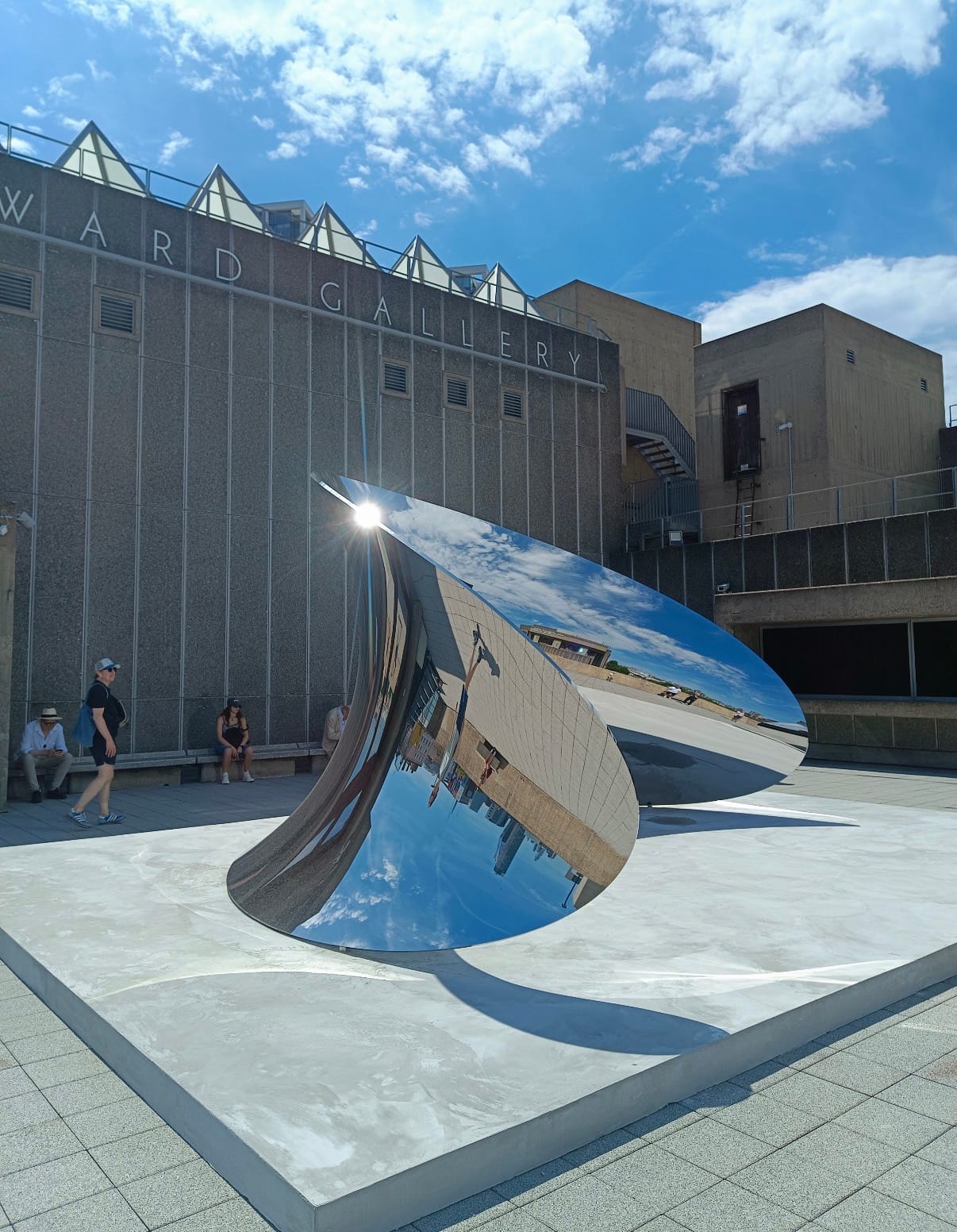
Hissteel objects are far more soothing, raising questions of physics rather than religion. Gleaming in the scorching sun, they reflect only the city, not our deep hidden inner voices. Here, at last, you can breathe out and play with the refraction of your own body or the surrounding space: look into them and you disappear, or appear much larger or smaller, closer or further away. These objects flip and compress the London skyline, or turn the plastered concrete of the gallery's exterior walls into living canvases.
On the Blackest Black
The Vantablack works — a substance made of carbon nanotubes that absorbs 99.965% of all light that hits it — never fail to astonish: flat black shapes on the wall or floor that, when you look into rather than at them, expand into bottomless voids. The seductive velvety surface compels the viewer to circle the object again and again, switching between two and three dimensions. At a certain angle, the volumetric depths suddenly vanish and the surface becomes flat once more. It's almost impossible to understand when or how this happens.
Instead of a conclusion
The exhibition covers almost every strand of Kapoor's practice, with the exception of his moving objects. If I could swap anything out, I'd have replaced the Ritual Atonements — one bloody rite has already been described for us. What I longed for was to meditate before sculptures with their captivating slow rotations on their own axis, as is possible with My Red Homeland (2003) or giant bell-shaped sculpture Untitled (2010).
That didn't happen for us this time — but Kapoor, in his creative process, has been on a relentless journey of exploring phenomena and materials. His sculptures force you to confront what cannot be fully explained: emptiness, fear, the sacred, infinity. He never provides answers, but searches for them himself in the act of making. He reflects on where we were before birth and where we will go after death, on what it feels like to experience the void — and to find yourself turned upside down.
By Valeria Ivanova
Art journalist, museologist, researcher