
Who Decides What We See? A Brief History of Censorship in Cinema
From Hollywood’s moral policing to films made in prison, under house arrest and at the service of dictators, the history of cinema is also a history of attempts to control it.
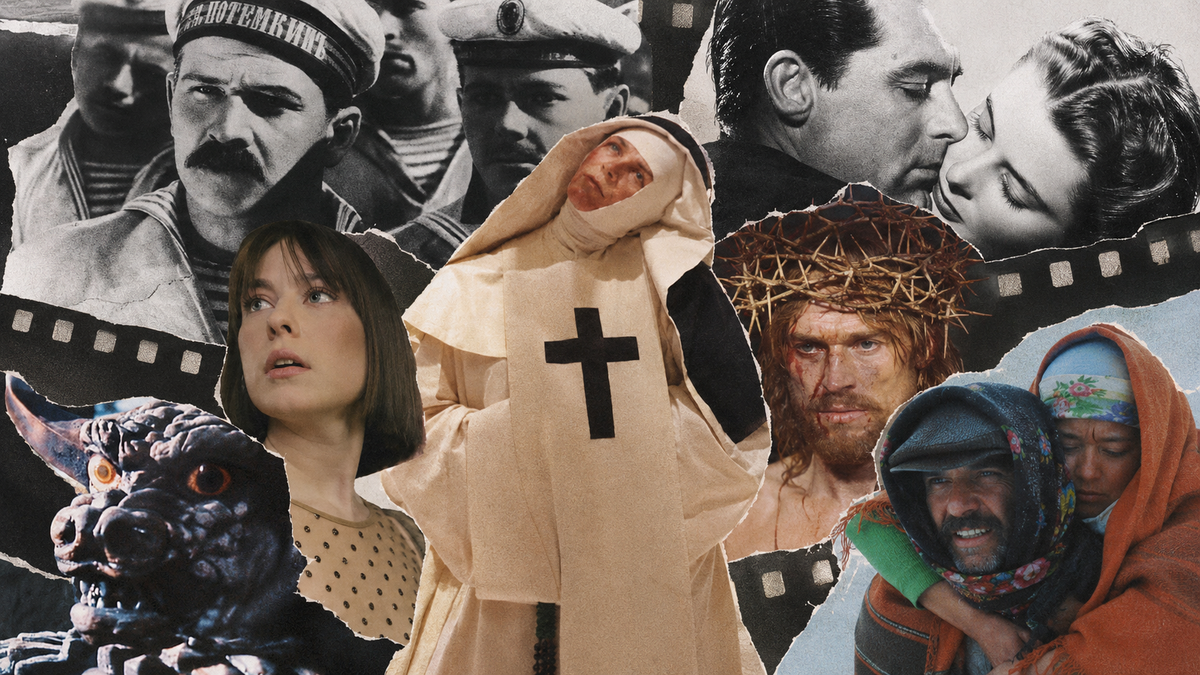
Cinema has never been particularly good at behaving itself. As soon as moving images became a form of mass entertainment, governments, religious organisations, and the film industry itself began to worry about what audiences were allowed to see.
Sex, violence, religion, homosexuality, political dissent and even the representation of marriage have all been considered dangerous enough to warrant intervention at different points in film history.
But censorship is not always as straightforward as banning a film. Sometimes it means removing a single scene, rewriting an ending, denying a filmmaker funding or preventing a film from reaching cinemas. In more extreme cases, it means imprisoning the director. And sometimes, rather than stopping filmmakers from making films, those in power force them to make particular ones.
The subject is also at the heart of Under Pressure, the latest season of the MUBI Podcast. Hosted by Rico Gagliano and inspired by Jafar Panahi's It Was Just an Accident, the season looks at filmmakers who have faced censorship, imprisonment and political pressure throughout cinema history. Using the podcast as our starting point, we look back at films that have challenged the limits of what could be made and shown.
When Hollywood decided what was morally acceptable
In 1930, Hollywood adopted the Motion Picture Production Code, better known as the Hays Code. Strictly enforced from 1934, it established a set of moral guidelines that American filmmakers were expected to follow.
Among other things, the Code prohibited explicit representations of homosexuality, interracial romantic relationships between Black and white characters, and sympathetic portrayals of certain criminal activities. Marriage was to be respected, sexual relationships were carefully regulated, and wrongdoing could not simply go unpunished.
And it caused some self-censorship. Hollywood introduced its own restrictions partly to avoid more extensive government intervention.
Filmmakers responded by developing an entire language of suggestion. A closed bedroom door, an interrupted kiss or a carefully constructed piece of dialogue could communicate something that could not be shown directly.
Alfred Hitchcock's Notorious (1946), for example, famously worked around restrictions on prolonged kissing by having Ingrid Bergman and Cary Grant repeatedly interrupt their embrace without moving away from each other.
The Code was eventually replaced by an age-based classification system in 1968. But for more than three decades, an industry concerned with protecting public morality had effectively determined what desire, relationships and identities could look like on screen.
When politics becomes the problem
Battleship Potemkin (1925), Dir. Sergei Eisenstein
Today, Battleship Potemkin is practically compulsory viewing for film students. A century ago, however, it was considered politically dangerous.
Commissioned in the Soviet Union, Eisenstein's film dramatises the 1905 naval mutiny and uses revolutionary imagery to argue against oppression.
British authorities refused to approve the film for public exhibition, concerned about its revolutionary message. Although private screenings took place, it did not receive formal approval from the British Board of Film Censors until 1954.
The Battle of Algiers (1966), Dir. Gillo Pontecorvo
Shot in black and white with a documentary-like immediacy, The Battle of Algiers reconstructs the Algerian struggle for independence from French colonial rule.
The film won the Golden Lion at the Venice Film Festival in 1966, yet its reception in France was considerably less enthusiastic. Its representation of colonial violence and the Algerian independence movement made it politically contentious, and French audiences were largely prevented from seeing it for several years.
Sex, religion and the fear of offending
The Devils (1971), Dir. Ken Russell
Based on historical events in seventeenth-century France, Ken Russell's The Devils brings together religious fanaticism, sexuality, political corruption and institutional violence. Unsurprisingly, it caused considerable controversy.
Both Warner Bros. and the British film censors demanded alterations, resulting in multiple versions of the film. Its troubled distribution history continued for decades, demonstrating that studios themselves can exercise considerable control over the preservation and circulation of cinema.
Remarkably, in 2026, the director's cut was finally classified uncut with an 18 certificate in the UK.
The Last Temptation of Christ (1988), Dir. Martin Scorsese
Scorsese's portrayal of Jesus as a figure struggling with human desires provoked protests from religious groups, particularly over a sequence imagining an alternative life in which Christ experiences marriage and intimacy.
Although the British Board of Film Classification approved the film, several local authorities banned screenings in their areas.
Making films when you are not allowed to
Yol (1982), Dir. Yılmaz Güney and Şerif Gören
While imprisoned in Turkey, Kurdish filmmaker Yılmaz Güney developed the screenplay and communicated detailed instructions to Şerif Gören, who directed the film on location. Güney subsequently escaped from prison and completed the editing in France.
The film follows five prisoners temporarily released from jail, exploring the extent to which political oppression, poverty and patriarchal traditions continue to restrict their lives outside prison.
In 1982, Yol jointly won the Palme d'Or at Cannes. Despite its international recognition, the film remained banned in Turkey for years and received a domestic theatrical release only in 1999.
This Is Not a Film (2011), Dir. Jafar Panahi and Mojtaba Mirtahmasb
In 2010, Iranian director Jafar Panahi was sentenced to six years in prison and a twenty-year ban on filmmaking. While under house arrest, he collaborated with documentary filmmaker Mojtaba Mirtahmasb to create This Is Not a Film.
Much of the film takes place inside Panahi's apartment. He talks on the phone, discusses an unrealised screenplay, feeds his pet iguana and reflects on the nature of filmmaking.
The simplicity is precisely what makes it so radical. If Panahi cannot legally direct a film, can he describe one? If he cannot create fictional characters, can he document himself? At what point does recording everyday life become filmmaking?
The work was smuggled out of Iran and screened at Cannes in 2011. Fourteen years later, Panahi won the Palme d'Or at Cannes for It Was Just an Accident (2025), a film exploring the psychological consequences of political repression and the complexities of revenge.
When filmmaking becomes compulsory
Pulgasari (1985), Dir. Shin Sang-ok
In 1978, South Korean actress Choi Eun-hee and director Shin Sang-ok were abducted and taken to North Korea. Kim Jong-il wanted to transform the country's film industry into something that could compete internationally.
The result was a series of films produced under extraordinary circumstances, including Pulgasari, a monster movie inspired by Korean folklore and Japanese kaiju cinema. Its central creature helps peasants rebel against a tyrannical ruler but eventually becomes a destructive force itself.
The film was intended to serve the state's ideological interests, although its narrative also lends itself to a rather uncomfortable interpretation of unchecked political power. Shin and Choi eventually escaped during a trip to Vienna in 1986.
Documenting censorship as it happens
My Undesirable Friends: Part I — Last Air in Moscow (2024), Dir. Julia Loktev
In 2021, filmmaker Julia Loktev travelled to Moscow to document the lives of independent Russian journalists facing increasing political pressure.
Over more than five hours, the documentary follows a group of journalists as their professional and personal lives become increasingly precarious. The designation of independent media workers as foreign agents, the restrictions imposed on reporting and the eventual necessity of leaving the country become part of their everyday reality.
Loktev spends as much time filming the journalists at home as she does at work. We see them joking with friends, chatting in their kitchens and getting on with their lives as the situation around them becomes increasingly difficult.
The invisible censor
It is tempting to think of film censorship as something from the past or tied to authoritarian political systems. Yet contemporary cinema faces its own forms of restriction.
International distribution, commercial interests, streaming platforms and the financial risks associated with controversial subjects can all influence which stories are told and which are abandoned before production begins.
A studio might avoid an LGBTQ+ storyline to protect access to particular markets. A distributor might decide that a politically sensitive documentary is not worth the controversy. A filmmaker might modify a script in anticipation of objections from investors or authorities.
Can censorship make cinema more creative?
A familiar argument is that restrictions encourage creativity. Hollywood filmmakers developed sophisticated visual metaphors under the Hays Code. Panahi turned his apartment into a film set. Güney made one of his most celebrated works from prison.
Of course, restrictions have sometimes pushed filmmakers to experiment with form and find new ways of telling stories. But it is easy to make that argument when looking at films that survived censorship and went on to become classics. We know far less about the filmmakers who abandoned their projects, changed their scripts beyond recognition or gave up making films altogether.
Looking back at the films that caused controversy in different countries and at different moments in history also tells us a great deal about the societies that made them. What was once considered morally unacceptable or politically dangerous might seem perfectly ordinary to audiences today. It makes you wonder which films we are missing out on now, and whether we will ever get to see them.
For more on the stories behind these films, listen to Under Pressure, the 12th season of the MUBI Podcast. Among the guests are filmmakers Alejandro G. Iñárritu, Fatih Akin, Julia Loktev, and Ali Abbasi, who discuss the realities of making cinema under political pressure.
Also, read our interview with Rico Gagliano, host of the MUBI Podcast, on the role of music in cinema.
 Hyper Culture Collective

Subscribe to our newsletter!
Weekly and monthly roundups of the best of London.