An Exhibition in Flux: Hans Ulrich Obrist on Justin Caguiat’s Change Ringing
“He wants the work to look different every time you see it”. Hans Ulrich Obrist reflects on Caguiat’s interdisciplinary practice, the relationship between sound and space, and art conceived to resist fixed form.
On October 8, Serpentine South opens Change Ringing, Justin Caguiat’s first institutional exhibition in the UK. Bringing together painting, sculpture, printmaking, sound, and film, the exhibition transforms the gallery into a new environment shaped by bells, heat, light, and architecture. We spoke with Serpentine Artistic Director Hans Ulrich Obrist about Caguiat’s practice, the ideas behind the installation, and works that are conceived to remain in a constant state of transformation.
This is Justin Caguiat’s first institutional exhibition in the UK. Why did this feel like the right moment to introduce his practice to audiences here?
We have been following Justin Caguiat’s work for many years. Born in Tokyo in 1989, he has always had a highly interdisciplinary practice, exploring relationships between architecture, spirituality, and ritual in everyday life. It felt exciting to bring all these dimensions together for the first time, as no exhibition had previously presented his printmaking, sculpture, painting, sound, and film as a Gesamtkunstwerk.
The project began in Madrid in spring, when we invited him to the Fundación Sandretto Re Rebaudengo project at the Santa Ana y la Esperanza Church, designed by Spanish architect Miguel Fisac. He created a Gesamtkunstwerk there, and we felt it would be wonderful to invite him to respond architecturally to the Serpentine’s space and create a Gesamtkunstwerk here as well. This is his first major institutional exhibition outside the US.
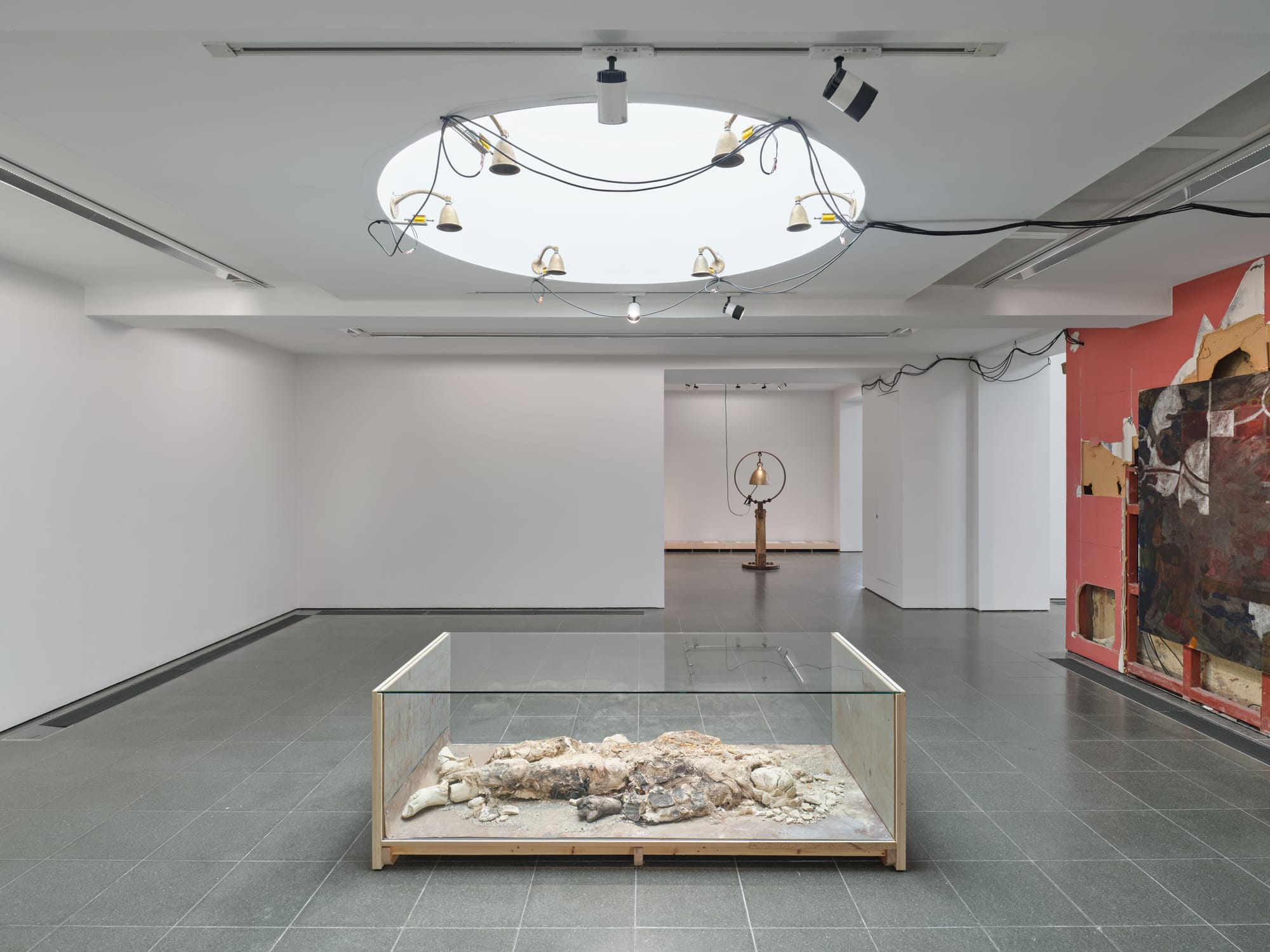
Justin’s work is often described as mysterious or difficult to pin down. How do you curate an exhibition like this without explaining away that ambiguity?
The exhibition is based on the show in Madrid at the Fundación Sandretto Re Rebaudengo, which Isabela Mora produced. For Natalia and me, as co-curators, it was important to present the work holistically while also giving visitors entry points. The accompanying booklet provides context without trying to resolve the work’s ambiguity.
For example, it explains how the Zodiac Machine reflects Justin's approach to architecture through acoustics: he uses bronze bells and sound to activate the space. It also offers historical context. The bells draw on a very old Russian Orthodox tradition of lost-wax casting, in which their tonality remains unknown until the casting is complete. They are not carved or altered afterward. Justin creates these bells in the forms of flowers, plants, and seeds, including poppies and also angel’s trumpets, plants associated with witchcraft. Together they form an automated sound sculpture. And that's also a connection to the English change ringing tradition. In churches, each bell is assigned a number, and the bells are rung in sequences based on these numbers. The score for the installation was composed by Justin's collaborator Lily Pickett. The whole gallery basically becomes a musical instrument.
We also provide context for Justin’s sculptures, which combine bread, wax, adobe and farm materials. There is a kind of alchemy in this process. In that sense, his practice connects to the work of the twentieth-century artist Sigmar Polke, who began experimenting with chemistry, growth and composition in the 1960s. Justin continues this kind of exploration in a distinctly twenty-first-century way.
The booklet also discusses the thermochromatic paintings: works on copper made with pigments that change colour in response to heat, light and sound. He painted them in complete darkness because the light-sensitive pigments degrade over time. He really wants the painting to look different every time one sees it. A feedback loop runs between the paintings and the bells. In this sense, the exhibition recalls the work of Roy Ascott, the pioneering British artist and teacher of Brian Eno, who explored feedback systems from the 1960s onwards.
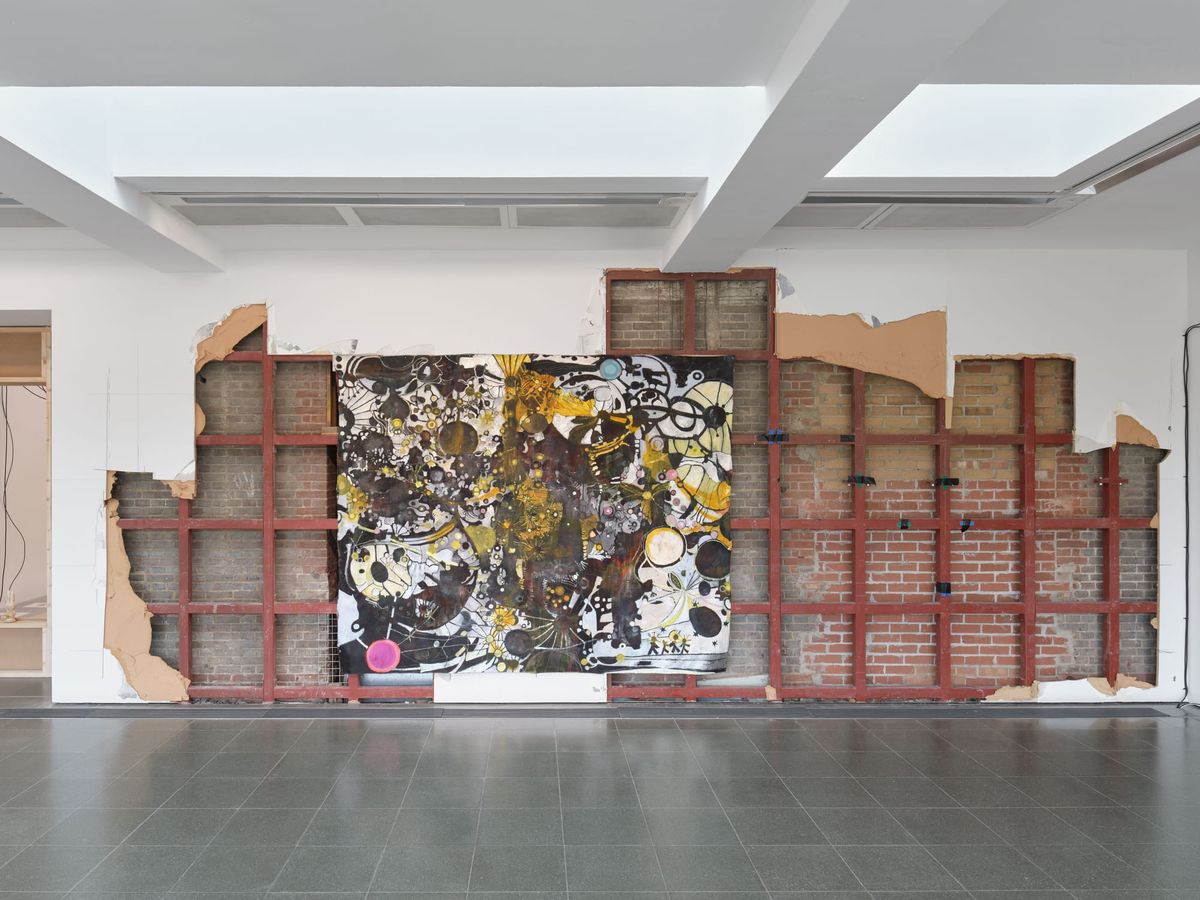
The entire exhibition can be understood as a feedback loop. At the centre of the exhibition – although not literally in the centre – are the unstretched paintings he is best known for. These cosmic works are like murals. At the Serpentine, they are shown against rough walls from which the plasterboard has been removed, exposing the building’s original brickwork and connecting the works to the architecture beyond the gallery.
And in Madrid, the Zodiac Machine was not only exhibited in the Santa Ana y la Esperanza Church, but also in the nearby Moratalaz Market and public spaces. So the paintings were like murals, and they are like murals. The paintings bring different perspectives together. Justin describes these perspectives as pushing against one another without ever settling into a cohesive compositional form. The work approaches the edge of collapse while maintaining harmony and coherence; it is fragmented and coherent at the same time.
The exhibition also presents him as an extraordinary printmaker and filmmaker, revealing the full breadth of his practice without reducing it to a single explanation.
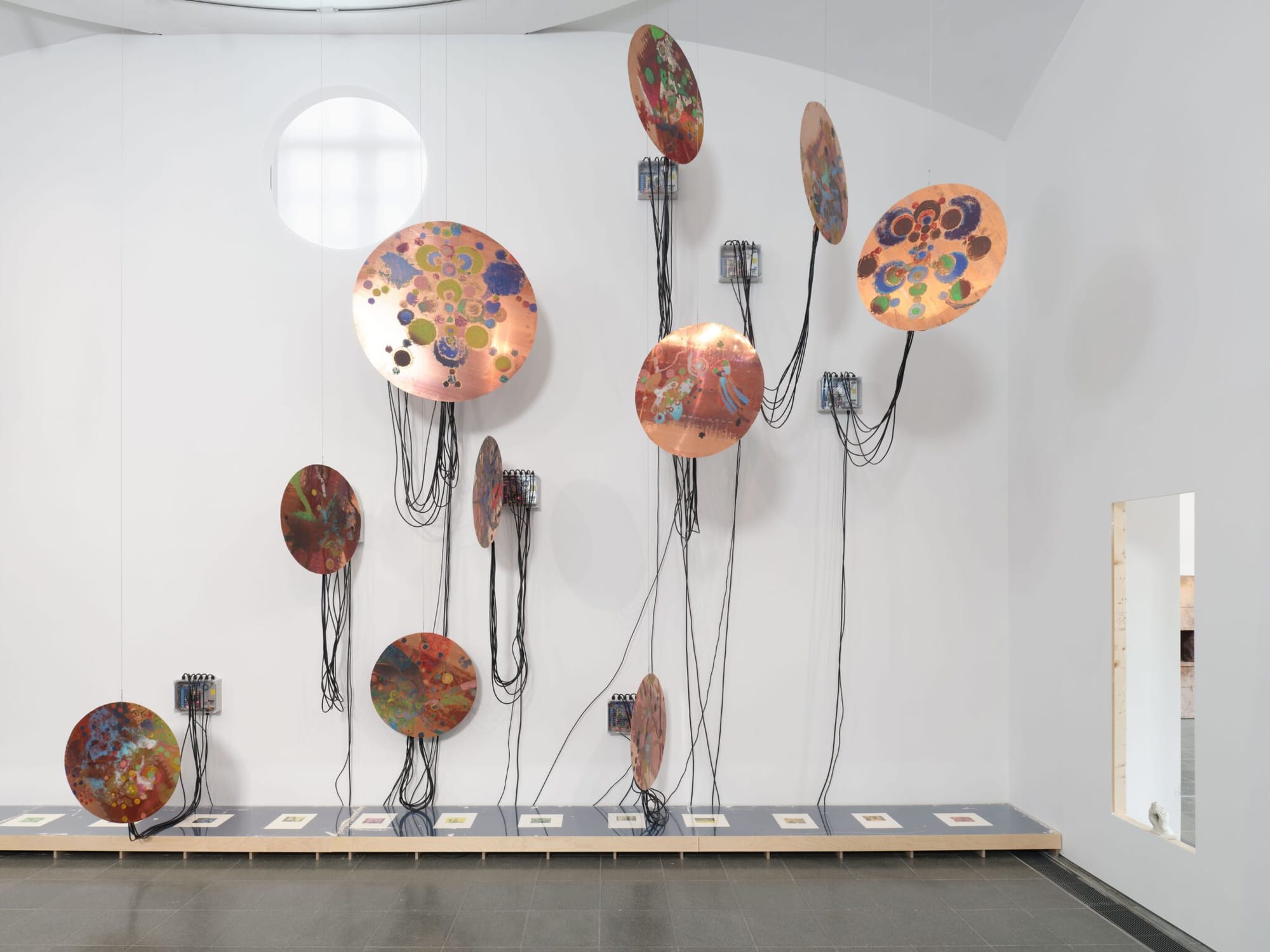
What did you discover about Caguiat’s practice through developing this exhibition that was not apparent at the beginning of the process?
We visited Justin regularly and had many long conversations. I saw him in his New York studio and visited him three times in San Francisco. He has now moved to London, just a few weeks before the opening, so his arrival in the city coincides in an exciting way with the exhibition.
Throughout this process, I kept discovering new dimensions to his practice. I already knew his films and paintings, but I came to understand him as an extraordinary printmaker and sonic artist who creates holistic sound installations. I also discovered him as a poet, through his beautiful book of poetry, and as a sculptor working with alchemical combinations of bread and other materials.
His practice has many dimensions – almost like superstring theory in quantum physics. Each encounter revealed another aspect of Justin Caguiat.
Was there a particular work, conversation, or moment during the making of the exhibition that changed the way you understood Justin’s practice?
I think the thermochromatic paintings made me understand his practice more. Through them, I realised how deeply rooted his work is in the idea of change. He wants the work to look different every time you see it. In that sense, he wants the work to behave almost like a living organism.